16. Learning Rate Comparison
Download PDFLearning Rate Comparison
Learning Goal
Understand how learning rate affects training speed and stability.
Key Concept
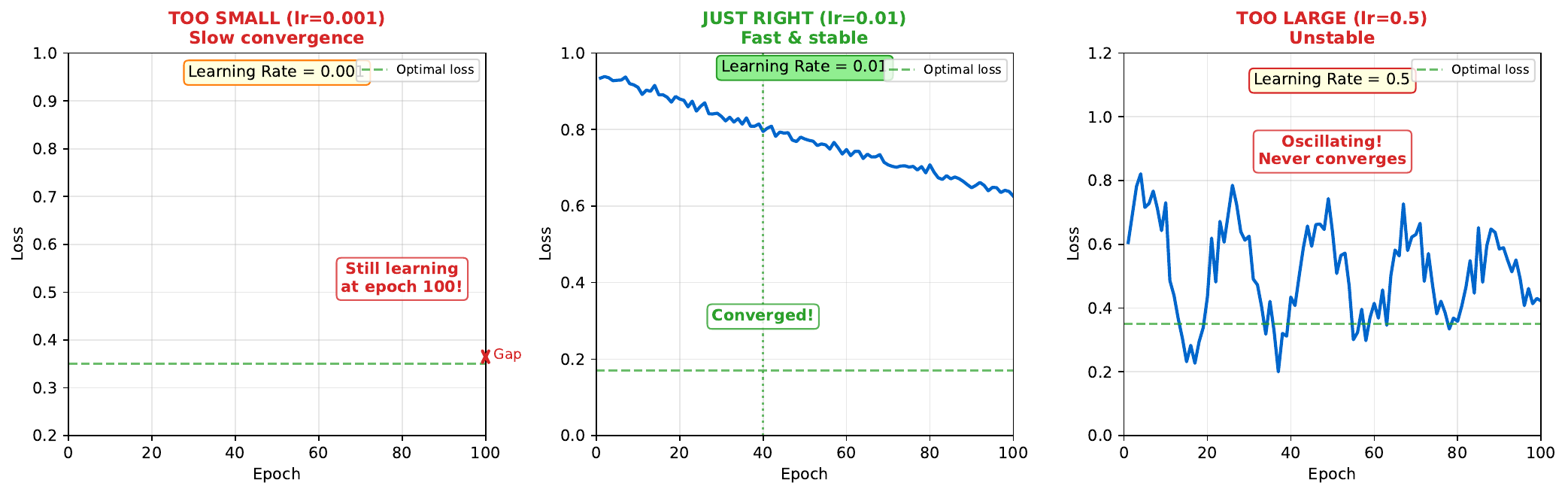
The learning rate controls how big a step we take during gradient descent. It’s one of the most important hyperparameters in neural network training.
Too small (e.g., 0.0001): Training is stable but extremely slow. The network may never reach a good solution in reasonable time.
Too large (e.g., 1.0): Training is unstable. The loss may oscillate wildly or even diverge to infinity. The network overshoots the minimum.
Just right (typically 0.001-0.01): Steady progress toward minimum. Fast enough to converge in reasonable time, stable enough not to diverge.
Finding the optimal learning rate often requires experimentation. Techniques like learning rate schedules (reducing rate over time) and adaptive methods (Adam, RMSprop) help automate this process.
Visual
Key Formula
Weight update: \(w := w - \eta \cdot \nabla L\)
Effect of learning rate:
- Small eta: $\Delta w$ is small, slow movement
- Large eta: $\Delta w$ is large, fast but potentially unstable movement
Common learning rate schedules:
Step decay: \(\eta_t = \eta_0 \times \gamma^{\lfloor t/k \rfloor}\)
Exponential decay: \(\eta_t = \eta_0 \times e^{-\lambda t}\)
Intuitive Explanation
Imagine walking downhill with a blindfold:
- Too small step: You inch forward, taking forever to reach the bottom
- Too large step: You leap so far you might land on the opposite hill
- Just right: Steady steps that make good progress without losing balance
The terrain (loss landscape) determines what “just right” means. Steeper hills allow smaller steps; flat areas can use larger steps.
Practice Problems
Problem 1
You train with learning rate 0.1 and observe: Loss at epoch 1 = 0.8, epoch 2 = 0.5, epoch 3 = 0.4, epoch 4 = 0.38, epoch 5 = 0.37. What pattern do you see?
Solution
**Pattern: Diminishing returns (normal convergence)** Analysis: - Epoch 1->2: Improvement of 0.3 (37.5% reduction) - Epoch 2->3: Improvement of 0.1 (20% reduction) - Epoch 3->4: Improvement of 0.02 (5% reduction) - Epoch 4->5: Improvement of 0.01 (2.6% reduction) This is **healthy training behavior**: - Rapid early progress (large gradients far from minimum) - Slowing improvement (smaller gradients near minimum) - Convergence to stable value The learning rate (0.1) appears appropriate for this problem.Problem 2
You train with learning rate 1.0 and observe: Loss at epoch 1 = 0.8, epoch 2 = 1.5, epoch 3 = 3.2, epoch 4 = 8.7, epoch 5 = NaN. What happened?
Solution
**Diagnosis: Learning rate too high - divergence** What happened: - Epoch 1->2: Loss increased (0.8 -> 1.5) - overshot minimum - Epoch 2->3: Continued increasing - oscillating past optimal - Epoch 3->4: Accelerating growth - unstable regime - Epoch 5: NaN (Not a Number) - loss exploded to infinity **Why:** - Large eta means large weight updates - Updates so large they jump past the minimum to higher loss regions - Positive feedback: higher loss -> larger gradient -> even larger update - Eventually overflows numerical precision (NaN) **Fix:** Reduce learning rate significantly (try 0.01 or 0.001)Problem 3
Describe how the Adam optimizer adjusts learning rate automatically.
Solution
**Adam (Adaptive Moment Estimation):** Adam adapts learning rate per-parameter based on: 1. **First moment (momentum)**: Running average of gradients $$m_t = \beta_1 m_{t-1} + (1-\beta_1) g_t$$ 2. **Second moment**: Running average of squared gradients $$v_t = \beta_2 v_{t-1} + (1-\beta_2) g_t^2$$ 3. **Bias correction**: $$\hat{m}_t = m_t / (1-\beta_1^t)$$ $$\hat{v}_t = v_t / (1-\beta_2^t)$$ 4. **Update**: $$w_t = w_{t-1} - \eta \cdot \frac{\hat{m}_t}{\sqrt{\hat{v}_t} + \epsilon}$$ **Effect:** - Parameters with large gradients get smaller effective learning rate - Parameters with small gradients get larger effective learning rate - Momentum smooths out noisy gradients **Typical defaults:** eta=0.001, beta1=0.9, beta2=0.999 This reduces manual tuning compared to vanilla gradient descent.Key Takeaways
- Learning rate is critical: too small = slow, too large = unstable
- Look for diminishing returns pattern = healthy training
- Look for increasing loss = learning rate too high
- Learning rate schedules reduce rate over time
- Adaptive optimizers (Adam) adjust rate automatically
(c) Joerg Osterrieder 2025