02. Single Neuron Computation
Download PDFSingle Neuron Computation
Learning Goal
Calculate the output of an artificial neuron step by step using concrete numbers.
Key Concept
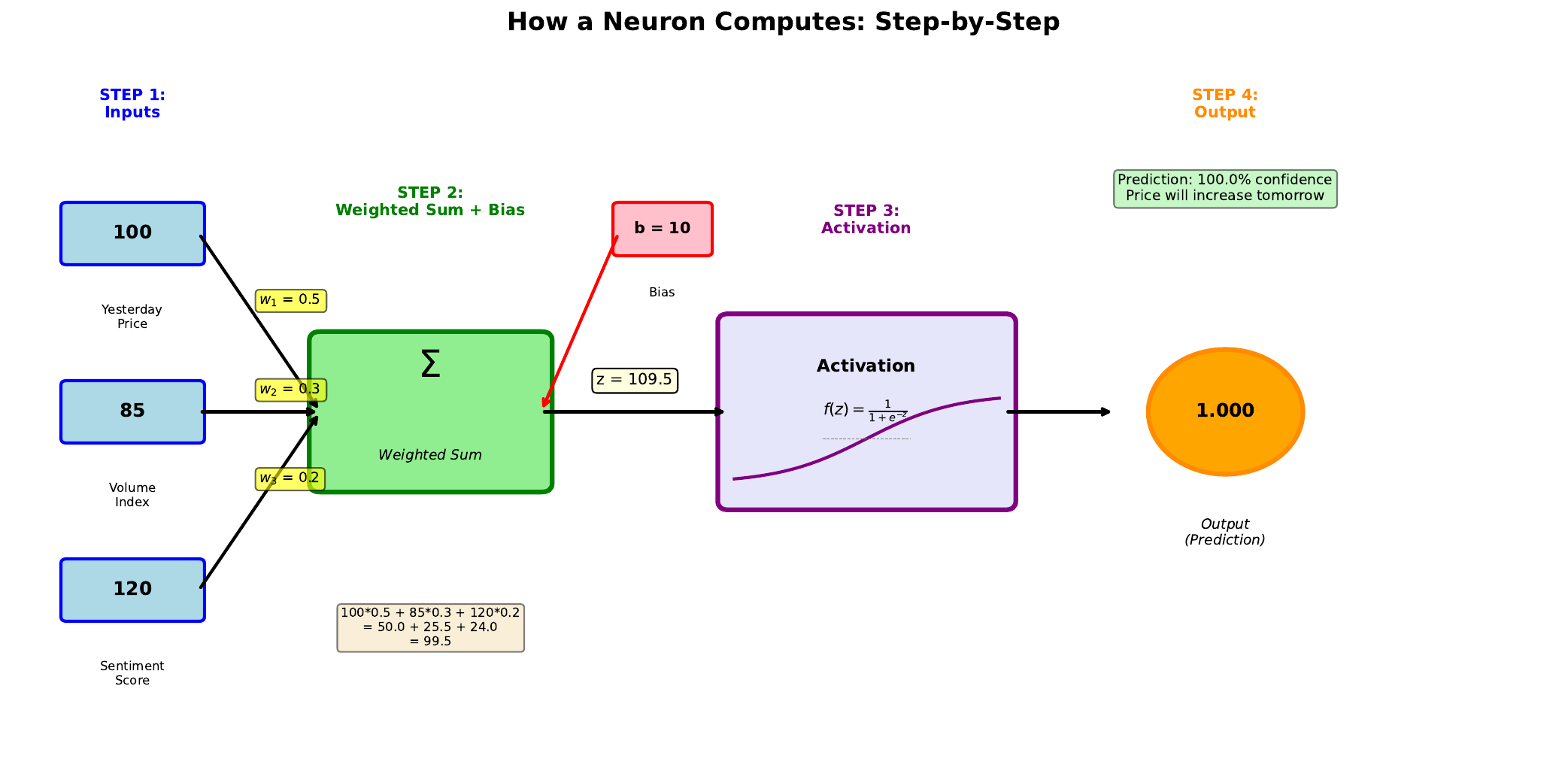
A single neuron performs two operations in sequence: first a weighted sum, then an activation function. Understanding this two-step process is essential for grasping how neural networks work.
Step 1: Weighted Sum - The neuron multiplies each input by its corresponding weight, sums all these products, and adds the bias. This produces a single number called the “pre-activation” value (often denoted z).
Step 2: Activation - The pre-activation value passes through an activation function (like sigmoid) that squashes it into a useful range. For the sigmoid function, any input is transformed to a value between 0 and 1, which we can interpret as a probability.
In business applications, we might use this to predict whether a stock price will rise. The inputs could be yesterday’s price change, trading volume, and market sentiment. The output probability tells us the network’s confidence in a price increase.
Visual
Key Formula
Step 1: Weighted Sum \(z = w_1 x_1 + w_2 x_2 + w_3 x_3 + b\)
Step 2: Sigmoid Activation \(y = \sigma(z) = \frac{1}{1 + e^{-z}}\)
Where:
- z = pre-activation (weighted sum)
- y = output probability (between 0 and 1)
- e = Euler’s number (approximately 2.718)
Intuitive Explanation
Think of the weighted sum as a “score” that combines all available information. A high positive score suggests the answer is likely “yes” (price will rise), while a negative score suggests “no.”
The sigmoid function converts this unbounded score into a probability. No matter how extreme the score, the output stays between 0 and 1. A score of 0 gives exactly 0.5 (50-50 chance). Positive scores give probabilities above 0.5, negative scores below.
Practice Problems
Problem 1
Given inputs Price = 1.2, Volume = 0.8, Sentiment = 0.6, with weights w1 = 0.5, w2 = 0.3, w3 = 0.4 and bias b = -0.5, calculate the weighted sum z.
Solution
$$z = w_1 \cdot \text{Price} + w_2 \cdot \text{Volume} + w_3 \cdot \text{Sentiment} + b$$ $$z = (0.5)(1.2) + (0.3)(0.8) + (0.4)(0.6) + (-0.5)$$ $$z = 0.60 + 0.24 + 0.24 - 0.50$$ $$z = 0.58$$Problem 2
Using z = 0.58 from Problem 1, calculate the sigmoid output. What is the predicted probability of price increase?
Solution
$$y = \frac{1}{1 + e^{-0.58}}$$ First calculate e^(-0.58): $$e^{-0.58} \approx 0.560$$ Then: $$y = \frac{1}{1 + 0.560} = \frac{1}{1.560} \approx 0.641$$ The neuron predicts a **64.1% probability** of price increase. Since 0.641 > 0.5, the prediction would be "BUY" (price likely to rise).Problem 3
What weighted sum z would give exactly 50% probability (y = 0.5)?
Solution
We need to find z such that: $$\frac{1}{1 + e^{-z}} = 0.5$$ Solving: $$1 = 0.5(1 + e^{-z})$$ $$2 = 1 + e^{-z}$$ $$e^{-z} = 1$$ $$-z = \ln(1) = 0$$ $$z = 0$$ When **z = 0**, the sigmoid output is exactly 0.5. This is the decision boundary - the point of maximum uncertainty.Key Takeaways
- Neuron computation has two steps: weighted sum, then activation
- The weighted sum can be any real number (positive, negative, or zero)
- Sigmoid squashes the weighted sum to a probability between 0 and 1
- z = 0 corresponds to 50% probability (maximum uncertainty)
(c) Joerg Osterrieder 2025