12. Feature Hierarchy
Download PDFFeature Hierarchy
Learning Goal
Understand how different layers learn increasingly abstract representations.
Key Concept
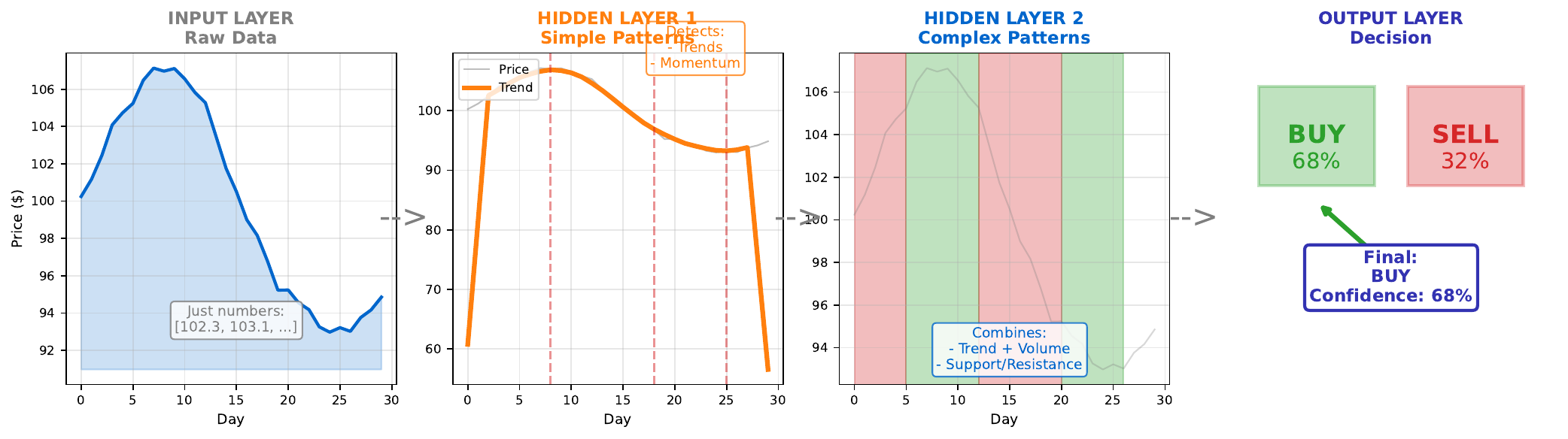
Neural networks learn hierarchical representations. Each layer transforms the data into a more abstract form:
- Input layer: Raw features (price, volume, sentiment)
- Hidden layer 1: Simple patterns (uptrend, high volume, positive sentiment)
- Hidden layer 2: Combinations (momentum + volume spike = strong signal)
- Output layer: Final decision (BUY/SELL with confidence)
This hierarchy emerges automatically through training. The network learns what intermediate representations are useful for the final task. Early layers detect simple patterns; later layers combine these into complex concepts.
In image recognition, this is visible: early layers detect edges, middle layers detect shapes, late layers detect objects. For financial data, the learned features are less visually interpretable but follow the same principle.
Visual
Key Formula
Layer-by-layer transformation:
\[h^{[1]} = f(W^{[1]} x + b^{[1]}) \quad \text{(simple patterns)}\] \[h^{[2]} = f(W^{[2]} h^{[1]} + b^{[2]}) \quad \text{(complex patterns)}\] \[\hat{y} = \sigma(W^{[3]} h^{[2]} + b^{[3]}) \quad \text{(decision)}\]Each layer builds on the representations from the previous layer.
Intuitive Explanation
Think of a corporate decision-making process:
- Analysts (Input): Collect raw data - stock prices, trading volumes
- Junior managers (Hidden 1): Identify simple patterns - “prices rising,” “unusual volume”
- Senior managers (Hidden 2): Combine patterns - “rising prices + high volume = momentum”
- Executive (Output): Make final call - “Confidence: 68% BUY”
Each level adds interpretation and abstraction. The executive doesn’t need raw numbers - they need the synthesized judgment of their team.
Practice Problems
Problem 1
A network for fraud detection has 3 hidden layers. What might each layer learn?
Solution
**Layer 1 - Simple anomalies:** - Transaction amount unusually high - Time of transaction (late night) - Location different from usual - Transaction frequency spike **Layer 2 - Pattern combinations:** - High amount + unusual time = suspicious - New location + high frequency = potential card theft - Normal amount + normal patterns = likely legitimate **Layer 3 - Complex fraud signatures:** - Combination of multiple suspicious patterns - Sequential transaction patterns (testing then big purchase) - Network of related suspicious accounts **Output - Fraud score:** - Probability of fraud (0-100%) - Decision threshold (e.g., flag if > 80%) Each layer abstracts further from raw data toward the final fraud determination.Problem 2
Why can’t we interpret what middle layer neurons have learned as easily as input features?
Solution
**Reasons for difficulty:** 1. **Distributed representations**: Information is spread across many neurons, not localized in one 2. **Non-linear combinations**: Each neuron combines inputs in complex, non-intuitive ways 3. **No predefined meaning**: Unlike "price" or "volume," hidden neurons learn their own abstract concepts 4. **Redundancy**: Multiple neurons may capture similar patterns in different ways 5. **Task-specific**: What neurons learn depends on the specific prediction task **Example:** Hidden neuron output might be: 0.73 What does 0.73 mean? It's a combination of multiple inputs, transformed non-linearly. It represents "something useful for prediction" but not a human-interpretable concept. **Research area**: "Interpretability" or "Explainable AI" tries to understand these learned representations.Problem 3
Does adding more layers always improve performance?
Solution
**No** - more layers is not always better. **Potential benefits:** - Deeper hierarchies can represent more complex patterns - Each layer can specialize in different abstraction levels - Sometimes necessary for very complex tasks **Potential problems:** 1. **Vanishing gradients**: Deep networks may not train well (especially with sigmoid) 2. **Overfitting**: More layers = more parameters = higher overfit risk 3. **Diminishing returns**: Simple problems don't need deep hierarchies 4. **Computational cost**: Training time increases significantly 5. **Degradation problem**: Very deep networks can perform worse than shallow ones (solved by residual connections) **Guidelines:** - Start simple (1-2 hidden layers) - Add depth only if needed - Use modern architectures (ResNets) for very deep networks - Match depth to problem complexityKey Takeaways
- Networks learn hierarchical representations automatically
- Early layers: simple patterns; Later layers: complex combinations
- Deeper networks can represent more abstract concepts
- Hidden representations are often not human-interpretable
- More layers isn’t always better - match complexity to problem
(c) Joerg Osterrieder 2025