04. Neuron Decision Maker
Download PDFNeuron Decision Maker
Learning Goal
See how a single neuron makes buy/sell decisions using a threshold.
Key Concept
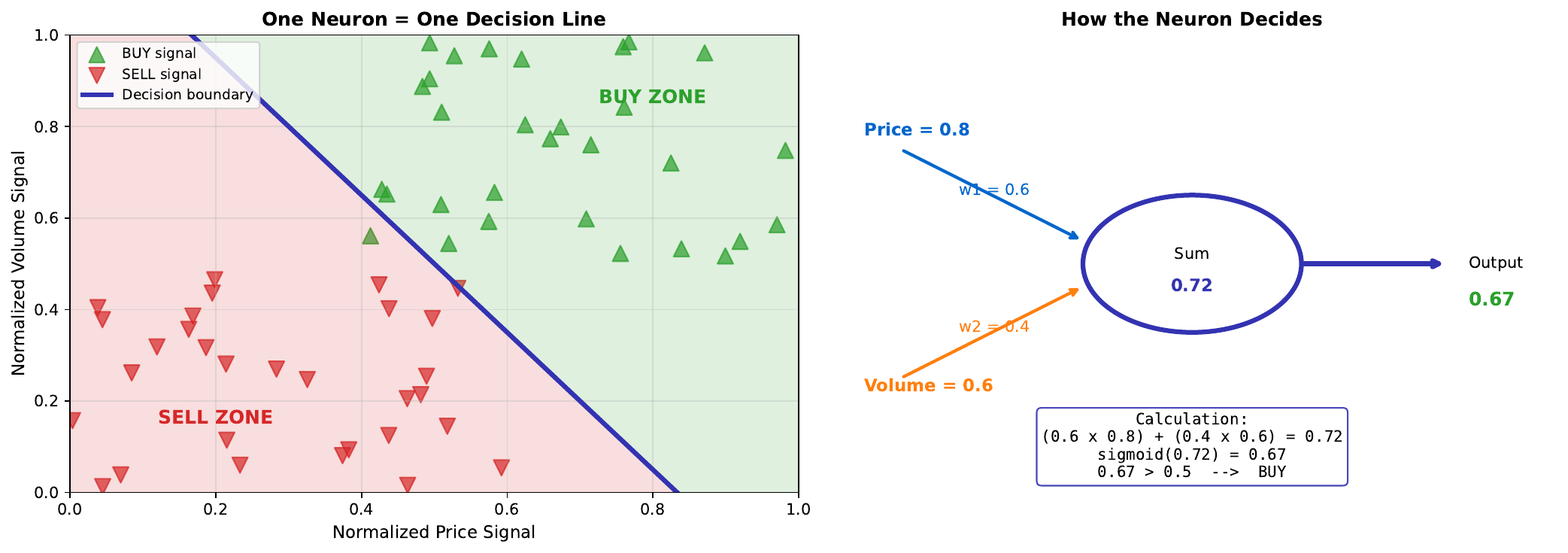
A single neuron acts as a decision maker by comparing its output to a threshold. For binary classification with sigmoid activation:
- Output > 0.5: Predict Class 1 (BUY)
- Output <= 0.5: Predict Class 0 (SELL)
The neuron computes a weighted combination of inputs, transforms it through the sigmoid function, and produces a probability. The threshold converts this probability into a discrete decision.
In trading terms: if the neuron outputs 0.67 (67% confidence in price increase), the decision is BUY. If it outputs 0.33 (33% confidence), the decision is SELL.
The position of the decision boundary in feature space corresponds to where the neuron output equals exactly 0.5 - the point of maximum uncertainty.
Visual
Key Formula
Neuron computation: \(z = w_1 x_1 + w_2 x_2 + b\) \(\hat{y} = \sigma(z) = \frac{1}{1 + e^{-z}}\)
Decision rule: \(\text{Decision} = \begin{cases} \text{BUY} & \text{if } \hat{y} > 0.5 \\ \text{SELL} & \text{if } \hat{y} \leq 0.5 \end{cases}\)
Boundary condition (y-hat = 0.5): \(z = 0 \implies w_1 x_1 + w_2 x_2 + b = 0\)
Intuitive Explanation
Think of the neuron as a judge weighing evidence:
- Gather evidence: Each input (price, volume) provides information
- Weight importance: Some evidence matters more (larger weights)
- Combine and evaluate: Sum weighted evidence, adjust by bias
- Confidence level: Sigmoid converts to 0-100% confidence
- Make decision: If confidence > 50%, rule in favor (BUY)
The weights encode what the neuron has learned about which inputs matter and how much.
Practice Problems
Problem 1
A neuron has weights w1 = 0.6 (for price), w2 = 0.4 (for volume), and bias b = -0.3. Given price = 0.8 and volume = 0.5, what is the decision?
Solution
**Step 1: Weighted sum** $$z = 0.6(0.8) + 0.4(0.5) + (-0.3)$$ $$z = 0.48 + 0.20 - 0.30 = 0.38$$ **Step 2: Sigmoid activation** $$\hat{y} = \frac{1}{1 + e^{-0.38}} = \frac{1}{1 + 0.684} = 0.594$$ **Step 3: Decision** Since 0.594 > 0.5: **Decision: BUY** (59.4% confidence in price increase)Problem 2
Using the same neuron, what values of (price, volume) lie exactly on the decision boundary?
Solution
On the boundary, z = 0: $$0.6 \cdot \text{price} + 0.4 \cdot \text{volume} - 0.3 = 0$$ Solving for volume: $$\text{volume} = \frac{0.3 - 0.6 \cdot \text{price}}{0.4}$$ $$\text{volume} = 0.75 - 1.5 \cdot \text{price}$$ Example points on the boundary: - price = 0.0: volume = 0.75 - price = 0.5: volume = 0.0 - price = 0.3: volume = 0.3 These points all yield 50% confidence (maximum uncertainty).Problem 3
If we change the threshold from 0.5 to 0.7, how does this affect trading behavior?
Solution
**With threshold = 0.7:** - BUY only if y-hat > 0.7 (70% confidence required) - More conservative - fewer buy signals - Reduces false positives (buying when shouldn't) - May miss some true opportunities (false negatives) **Trade-offs:** | Threshold | BUY signals | False positives | Missed opportunities | |-----------|-------------|-----------------|---------------------| | 0.5 | Many | More | Fewer | | 0.7 | Fewer | Fewer | More | | 0.9 | Very few | Very few | Many | **In practice:** - Aggressive traders: lower threshold (0.5-0.6) - Conservative traders: higher threshold (0.7-0.8) - Threshold choice depends on asymmetric costs of errorsKey Takeaways
- A neuron outputs a probability via sigmoid activation
- Default threshold of 0.5 converts probability to binary decision
- The decision boundary is where output = 0.5 (z = 0)
- Threshold can be adjusted based on risk tolerance
- Single neuron = single linear decision boundary
(c) Joerg Osterrieder 2025