08. Boundary Evolution
Download PDFBoundary Evolution
Learning Goal
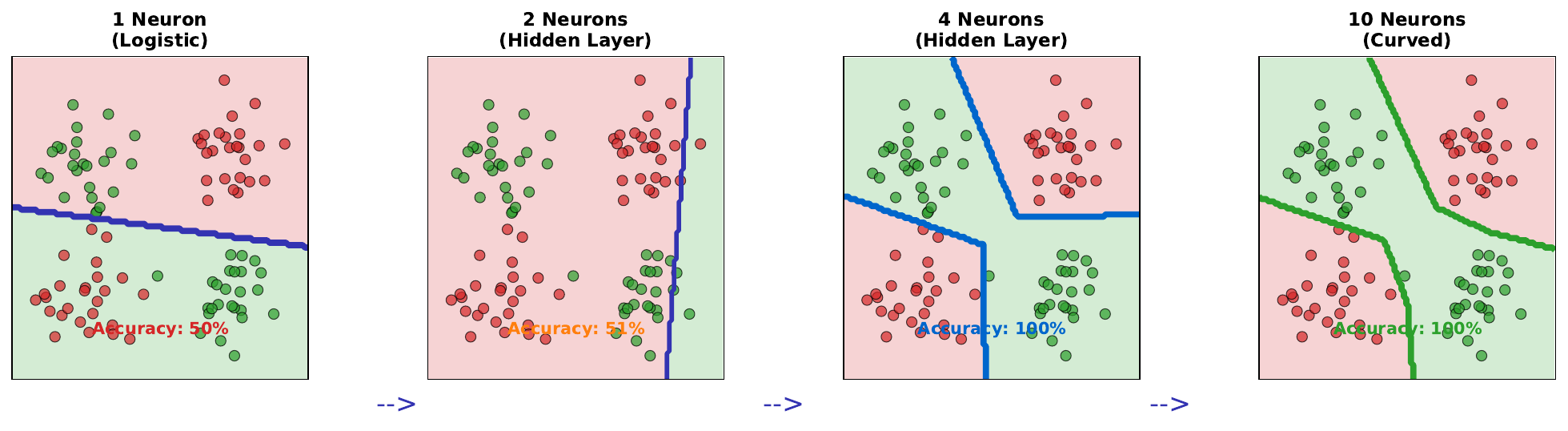
Observe how increasing the number of neurons improves decision boundaries.
Key Concept
The expressivity of a neural network - its ability to represent complex functions - increases with more neurons. This manifests as more flexible decision boundaries.
- 1 neuron: Can only create a straight line boundary. Fails on XOR-like patterns.
- 2-4 neurons: Can create piecewise linear boundaries with some curvature
- 10+ neurons: Can create smooth, curved boundaries that wrap around complex clusters
With enough neurons, a single hidden layer can theoretically approximate any continuous function (Universal Approximation Theorem). However, practical considerations (training time, overfitting) limit network size.
The key insight: more neurons = more capacity to represent complex patterns. But this capacity must be balanced against available training data to avoid overfitting.
Visual
Key Formula
Network capacity (approximate):
A single hidden layer with n neurons can represent boundaries with approximately n “bends” or segments.
Universal Approximation Theorem (informal): A feedforward network with one hidden layer containing a finite number of neurons can approximate any continuous function to arbitrary accuracy, given sufficient neurons.
Intuitive Explanation
Imagine drawing with different tools:
- 1 neuron: A single ruler - can only draw straight lines
- 2 neurons: Two rulers - can make an angle (V-shape)
- 4 neurons: A flexible curve with several bends
- 10 neurons: A smooth, complex curve that can wrap around clusters
Each neuron contributes one “bend” to the decision boundary. The more bends available, the more precisely the boundary can separate complex patterns.
Practice Problems
Problem 1
A dataset has an XOR pattern (like a checkerboard). What is the minimum number of hidden neurons needed to solve it with a single hidden layer?
Solution
**Minimum: 2 hidden neurons** XOR requires separating diagonal corners. With 2 neurons: - Neuron 1: Creates one linear boundary - Neuron 2: Creates another linear boundary - Combined: The intersection creates an XOR-compatible separation With 1 neuron: Only one straight line = cannot solve XOR Visualization: ``` Neuron 1: / Neuron 2: \ Combined: X ``` The two boundaries intersect, creating four regions that match XOR's four quadrants.Problem 2
You have 500 training samples. Would you use 10 neurons or 500 neurons in the hidden layer? Why?
Solution
**Use 10 neurons**, not 500. **Reasoning:** With 500 neurons: - Parameters (assuming 10 inputs): 10 x 500 + 500 + 500 x 1 + 1 = 6,001 - Parameters exceed training samples (6,001 > 500) - High risk of **overfitting** - network can memorize each training point - Poor generalization to new data With 10 neurons: - Parameters: 10 x 10 + 10 + 10 x 1 + 1 = 121 - Parameters much less than training samples (121 << 500) - Forces network to find **generalizable patterns** - Better expected test performance **Rule of thumb**: Keep parameters well below training samples.Problem 3
As neurons increase from 1 to 10, training accuracy improves from 50% to 100%. Is this necessarily good?
Solution
**Not necessarily** - we need to check test accuracy. **Scenarios:** | Neurons | Train Acc | Test Acc | Assessment | |---------|-----------|----------|------------| | 1 | 50% | 52% | Underfitting (too simple) | | 4 | 75% | 72% | Good generalization | | 10 | 100% | 70% | Possible overfitting | If 10 neurons achieves 100% training accuracy but test accuracy is lower than simpler models, we have **overfitting**. **Signs of overfitting:** - Training accuracy >> test accuracy - Perfect training accuracy (memorization) - Adding neurons improves training but hurts test **Solution**: Choose the model with best test accuracy (likely 4-6 neurons in this example), use regularization, or get more data.Key Takeaways
- More neurons = more flexible decision boundaries
- 1 neuron creates linear boundary; many neurons create curved boundaries
- Universal Approximation: enough neurons can fit any pattern
- But more neurons also increases overfitting risk
- Balance capacity with available data
(c) Joerg Osterrieder 2025