Syllabus
Course Information
Course Title: Neural Networks - From Brain to Business
Description: This course introduces neural networks from biological inspiration through to practical business applications in financial prediction. Students will understand how artificial neurons work, how networks learn, and how to evaluate their performance.
Prerequisites:
- Basic algebra (variables, equations, functions)
- Basic statistics (mean, probability, standard deviation)
- No programming experience required
Learning Objectives
Upon successful completion of this course, students will be able to:
- Explain the biological inspiration for artificial neural networks
- Calculate the output of neurons using weighted sums and activation functions
- Design appropriate network architectures for classification problems
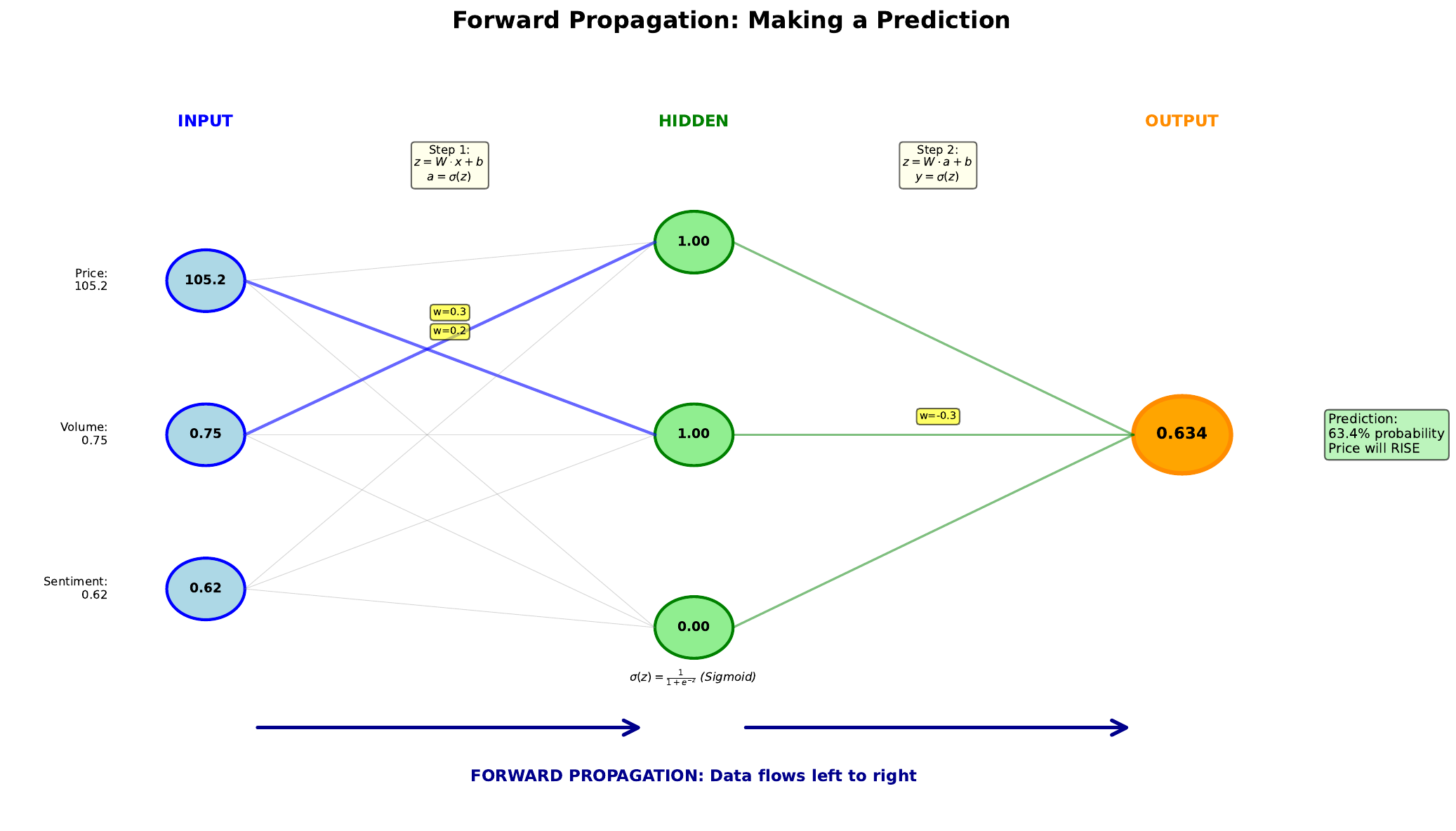
- Trace information flow through forward propagation
- Describe how gradient descent enables learning
- Diagnose training problems (overfitting, underfitting, learning rate issues)
- Evaluate model performance using confusion matrices and backtesting
Course Structure
Part 1: Foundations (Topics 01-04)
Objective: Understand the basic building blocks of neural networks
| Topic | Title | Key Concept |
|---|---|---|
| 01 | Biological Neuron | Biological inspiration |
| 02 | Single Neuron | Weighted sum and activation |
| 03 | Problem Visualization | Why simple rules fail |
| 04 | Neuron Decision Maker | Threshold-based decisions |
Part 2: Building Blocks (Topics 05-08)
Objective: Master activation functions and understand limitations
| Topic | Title | Key Concept |
|---|---|---|
| 05 | Activation Functions | Sigmoid, ReLU, Tanh |
| 06 | Linear Limitation | XOR problem |
| 07 | Sigmoid Saturation | Vanishing gradient |
| 08 | Boundary Evolution | More neurons = better boundaries |
Part 3: Network Architecture (Topics 09-12)
Objective: Design and understand multi-layer networks
| Topic | Title | Key Concept |
|---|---|---|
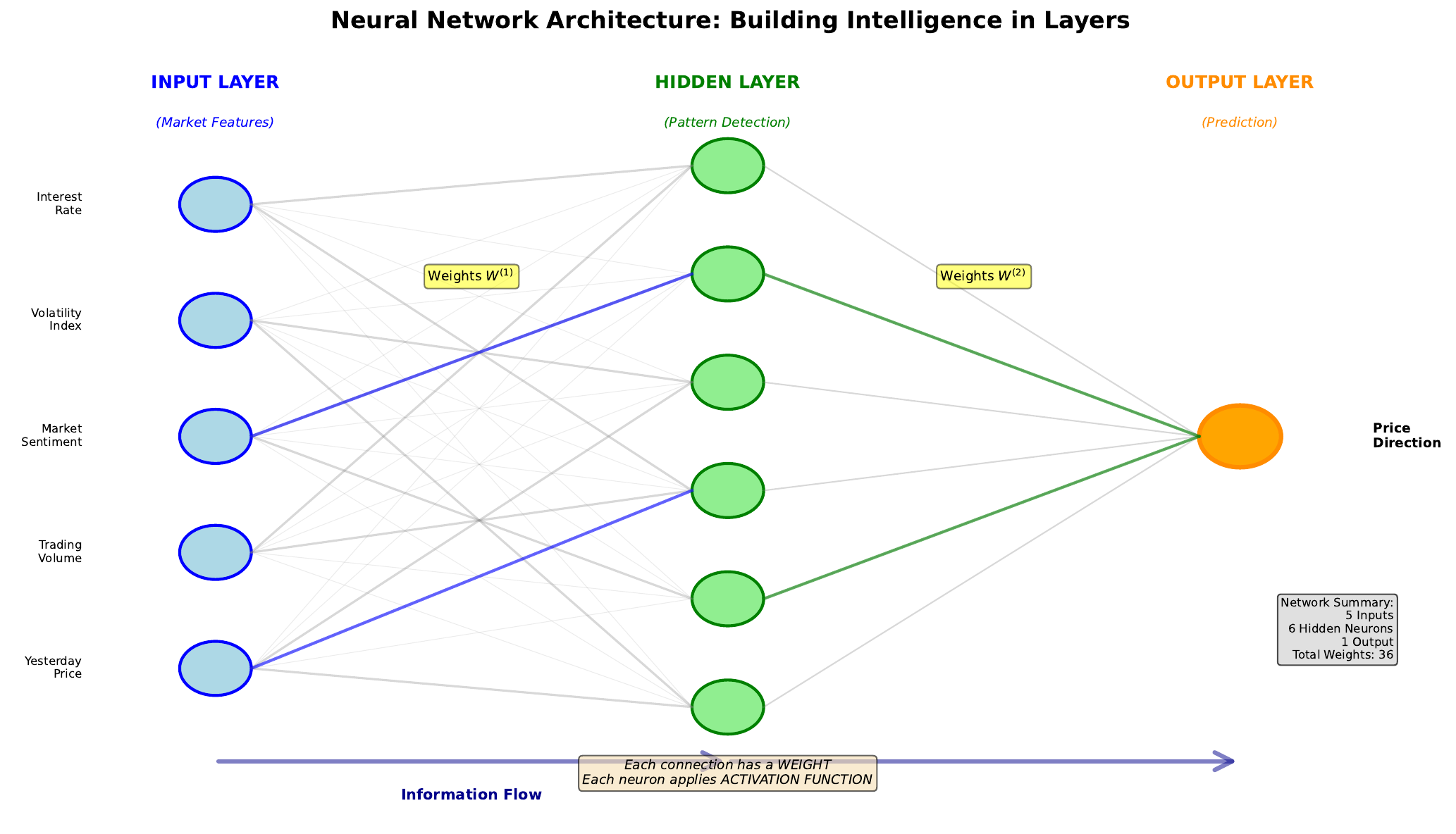
| 09 | Network Architecture | Layers and parameters |
| 10 | Forward Propagation | Computing predictions |
| 11 | Decision Boundary | Linear vs curved separation |
| 12 | Feature Hierarchy | Layer abstraction |
Part 4: Learning Process (Topics 13-16)
Objective: Understand how networks learn from data
| Topic | Title | Key Concept |
|---|---|---|
| 13 | Loss Landscape | Error surface |
| 14 | Gradient Descent | Weight updates |
| 15 | Overfitting/Underfitting | Training diagnostics |
| 16 | Learning Rate | Hyperparameter tuning |
Part 5: Application (Topics 17-20)
Objective: Apply neural networks to real business problems
| Topic | Title | Key Concept |
|---|---|---|
| 17 | Market Prediction Data | Feature engineering |
| 18 | Prediction Results | Before vs after training |
| 19 | Confusion Matrix | Performance metrics |
| 20 | Trading Backtest | Business value |
Assessment
Each topic includes 2-3 practice problems with solutions. Students should work through these problems to reinforce understanding.
Self-Assessment Checkpoints:
- After Part 1: Can you calculate a neuron’s output by hand?
- After Part 2: Can you explain why XOR requires hidden layers?
- After Part 3: Can you count parameters in a network architecture?
- After Part 4: Can you diagnose overfitting from learning curves?
- After Part 5: Can you interpret a confusion matrix?
Materials
Primary Resource:
- This GitHub Pages site with all topic pages and exercises
Supplementary:
- PDF Presentation - Full slide deck
- GitHub Repository - Source code for all visualizations
Contact
This course is part of the Digital-AI-Finance educational initiative.
For questions or feedback, please open an issue on the GitHub repository.
(c) Joerg Osterrieder 2025