A7: The Regulatory Race to the Bottom
Assignment Brief
Introduction
When countries compete for crypto businesses, they face a prisoner's dilemma (a situation where two players each have an incentive to act selfishly, even though cooperating would make both better off). This model uses game theory (the mathematical study of strategic decision-making) with a 3x3 payoff matrix (a table showing the outcome for every possible combination of strategies). Two countries simultaneously choose between Strict, Medium, or Lax regulation. A Nash equilibrium (a combination of strategies where neither player wants to change their choice, given what the other is doing) reveals the stable outcome.
The Baseline Payoff Matrix
Each cell shows the payoff for the row player (Country A). Country B receives symmetric payoffs (same matrix, but using columns as their strategy and rows as opponent strategy).
           Strict  Medium  Lax
Strict      7       4       2
Medium      8       6       3
Lax         9       7       4
Analysis:
- Lax is dominant (the best response regardless of opponent's choice):
- vs Strict: 9 > 8 > 7
- vs Medium: 7 > 6 > 4
- vs Lax: 4 > 3 > 2
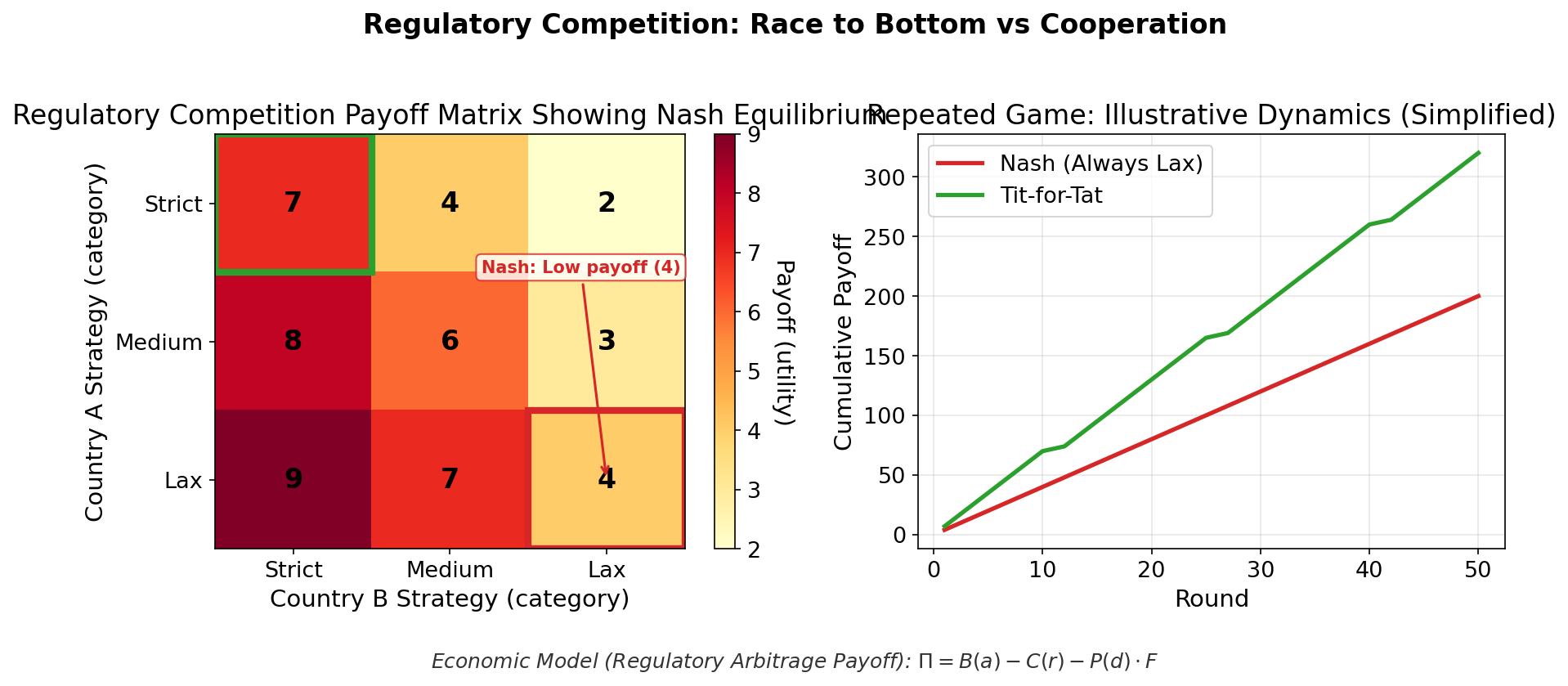
- Nash equilibrium: (Lax, Lax) = 4 for each country
- Cooperative outcome: (Strict, Strict) = 7 for each country (unstable)
The race to the bottom produces lower payoffs than cooperation, but no country can unilaterally improve by choosing stricter regulation.
Variations
Variation 1: Lax Penalty (-5)
Suppose international organizations impose a penalty of -5 on any country choosing Lax regulation. Subtract 5 from all Lax row payoffs AND all Lax column payoffs.
New Lax row: [9-5, 7-5, 4-5] = [4, 2, -1]
New Lax column (for row player): [2-5, 3-5, 4-5] = [-3, -2, -1]
Question: Where is the new Nash equilibrium? Is Lax still dominant?
Variation 2: Strict Subsidy (+3)
Suppose a global climate fund subsidizes strict regulators by +3. Add 3 to all Strict row payoffs.
New Strict row: [7+3, 4+3, 2+3] = [10, 7, 5]
Question: Is Strict now dominant? What is the Nash equilibrium?
Variation 3: Extended Game (200 Rounds)
Change the repeated game from 50 rounds to 200 rounds. Keep the same defection pattern (defection rounds at 10, 25, 40, each lasting 2 rounds).
Questions:
- How much does tit-for-tat (a strategy of copying the opponent's previous move) gain over always-Lax in 50 rounds?
- How much does tit-for-tat gain over always-Lax in 200 rounds?
- What does this tell you about the importance of long-term relationships?
Open Extension
Design a payoff matrix where (Medium, Medium) is the unique Nash equilibrium. Your matrix must satisfy:
- Medium is the best response to Medium
- Medium is the best response to Strict
- Medium is the best response to Lax
Provide your matrix and verify it mathematically.
How to Run
Use Google Colab to modify the provided Python code. The baseline chart shows the payoff matrix and repeated game dynamics. Your task is to create variations that demonstrate how penalties, subsidies, and repeated interaction affect equilibrium outcomes.
Time Allocation
- 45 minutes: Analysis and calculations
- 10 minutes: Presentation preparation
Learning Outcomes
After completing this assignment, you should be able to:
- Identify dominant strategies and Nash equilibria in normal-form games
- Explain how external incentives (penalties/subsidies) can shift equilibria
- Understand the role of repeated interaction in sustaining cooperation
- Apply game theory to real-world regulatory competition scenarios
Reference
Kanbur, R., & Keen, M. (1993). Jeux Sans Frontieres: Tax Competition and Tax Coordination When Countries Differ in Size. American Economic Review, 83(4), 877-892.
Model Answer
Show Model Answer Presentation
Slide 3 of 6
Baseline: Race to the Bottom
           Strict  Medium  Lax
Strict      7       4       2
Medium      8       6       3
Lax         9       7       4
Lax is dominant:
- vs Strict: 9 > 8 > 7
- vs Medium: 7 > 6 > 4
- vs Lax: 4 > 3 > 2
Nash equilibrium: (Lax, Lax) = 4
Cooperative outcome: (Strict, Strict) = 7 (unstable)
Slide 4 of 6
Variation 1: Lax Penalty (-5)
Modified Matrix (Lax penalty -5 applied to row AND column):
           Strict  Medium  Lax
Strict      7       4      -3
Medium      8       6      -2
Lax         4       2      -1
Best responses:
- vs Strict: Medium (8 > 7 > 4)
- vs Medium: Medium (6 > 4 > 2)
- vs Lax: Lax (-1 > -2 > -3)
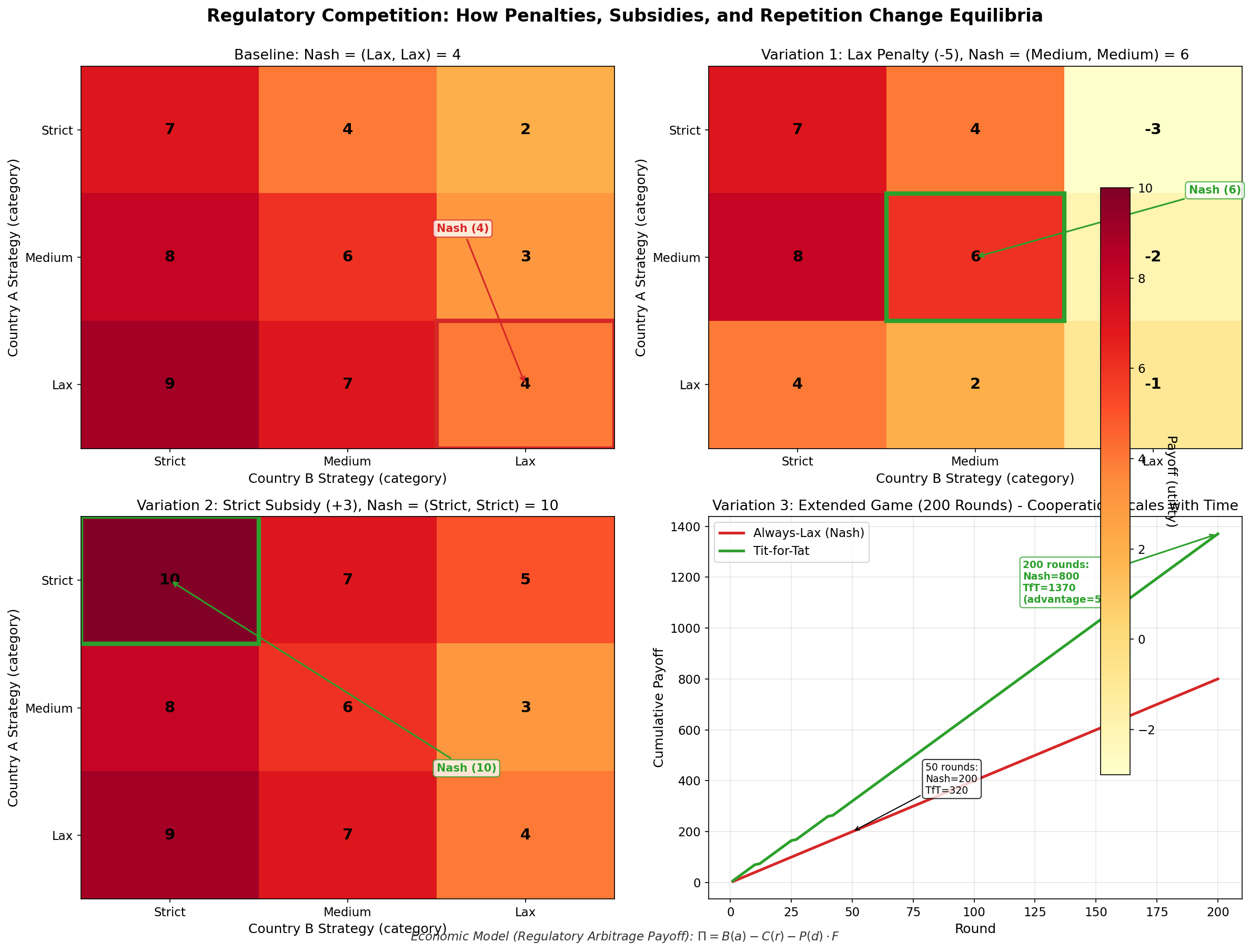
Nash equilibrium shifts to (Medium, Medium) = 6
Sanctions work! Punishment makes extreme arbitrage too costly.
Slide 5 of 6
Variation 2: Strict Subsidy (+3)
Modified Matrix (Strict subsidy +3):
           Strict  Medium  Lax
Strict     10       7       5
Medium      8       6       3
Lax         9       7       4
Best responses:
- vs Strict: Strict (10 > 9 > 8)
- vs Medium: Strict = Lax (7 = 7 > 6)
- vs Lax: Strict (5 > 4 > 3)
Strict is weakly dominant. Nash equilibrium: (Strict, Strict) = 10
Subsidy makes cooperation self-enforcing!
Slide 6 of 6
Variation 3: 200 Rounds (Repeated Interaction)
50 rounds:
- Always-Lax: 50 x 4 = 200
- Tit-for-tat: (44 x 7) + (6 x 2) = 308 + 12 = 320
- Advantage: 120
200 rounds:
- Always-Lax: 200 x 4 = 800
- Tit-for-tat: (194 x 7) + (6 x 2) = 1358 + 12 = 1370
- Advantage: 570
Cooperation gains scale with relationship length. The "shadow of the future" (the expectation of future interactions) makes cooperation more attractive.