A4: Network Effects in Payment Systems
Network Effects: When Does a Payment System Take Off?
Introduction
Network effects (the phenomenon where a product becomes more valuable as more people use it) determine when a payment system reaches critical mass (the point where enough people use it that growth becomes self-sustaining). Three theories model network value V as a function of n users:
- Metcalfe's Law: V = n²/1000 (every pair can connect)
- Odlyzko-Tilly: V = n·ln(n)/10 (only close contacts matter)
- Linear: V = n (no network effects)
The divisors (1000 and 10) normalize raw connection counts to comparable value units.
Key Concepts:
- Switching cost: the time, effort, and money needed to change from one payment system to another
- Critical mass: the number of users at which network value exceeds switching costs, making adoption self-sustaining
Your Task
You will explore how different network value models predict when payment systems reach critical mass under various switching cost scenarios.
Variations to Implement
- VARIATION 1 - Lower switching cost threshold from 500 to 100
- How does critical mass change for each model?
- Which model reaches critical mass fastest?
- VARIATION 2 - Raise switching cost to 2,000
- How does critical mass change?
- Which model never reaches critical mass within 1000 users?
- VARIATION 3 - Add Reed's Law
- Implement Reed's Law: V = 2^(n/10)
- Where does it cross the switching cost threshold (500)?
- How does it compare to the other models?
Open Extension (Advanced)
Remove the scaling divisors and use raw formulas:
- Metcalfe: V = n²
- Odlyzko-Tilly: V = n·ln(n)
- Linear: V = n
Questions:
- How do critical mass points change?
- What do the divisors represent economically?
- Why are they needed for realistic modeling?
How to Run
Use Google Colab or your local Python environment with matplotlib and numpy installed.
Time Allocation
- 45 minutes: Implementation and analysis
- 10 minutes: Presentation preparation
Deliverables
- Modified Python code implementing all three variations
- 7-slide presentation (use Marp or PowerPoint) summarizing your findings
- Brief written analysis of what the scaling factors mean economically
References
- Metcalfe, B. (2013). "Metcalfe's Law after 40 Years of Ethernet"
- Odlyzko, A., & Tilly, B. (2005). "A refutation of Metcalfe's Law and a better estimate for the value of networks and network interconnections"
Grading Criteria
- Correctness (40%): All three variations implemented correctly
- Analysis (30%): Clear explanation of critical mass changes
- Presentation (20%): Clear visualization and communication
- Extension (10%): Insight into scaling factors (bonus)
Show Model Answer Presentation
Slide 3
Baseline Results (Threshold = 500)
Critical mass points where V > 500:
- Linear: n = 500 (V = n, so n = 500)
- Metcalfe: n = 708 (n²/1000 = 500 → n = √500,000 ≈ 707.1)
- Odlyzko: n ≈ 750 (solve n·ln(n)/10 = 500 numerically)
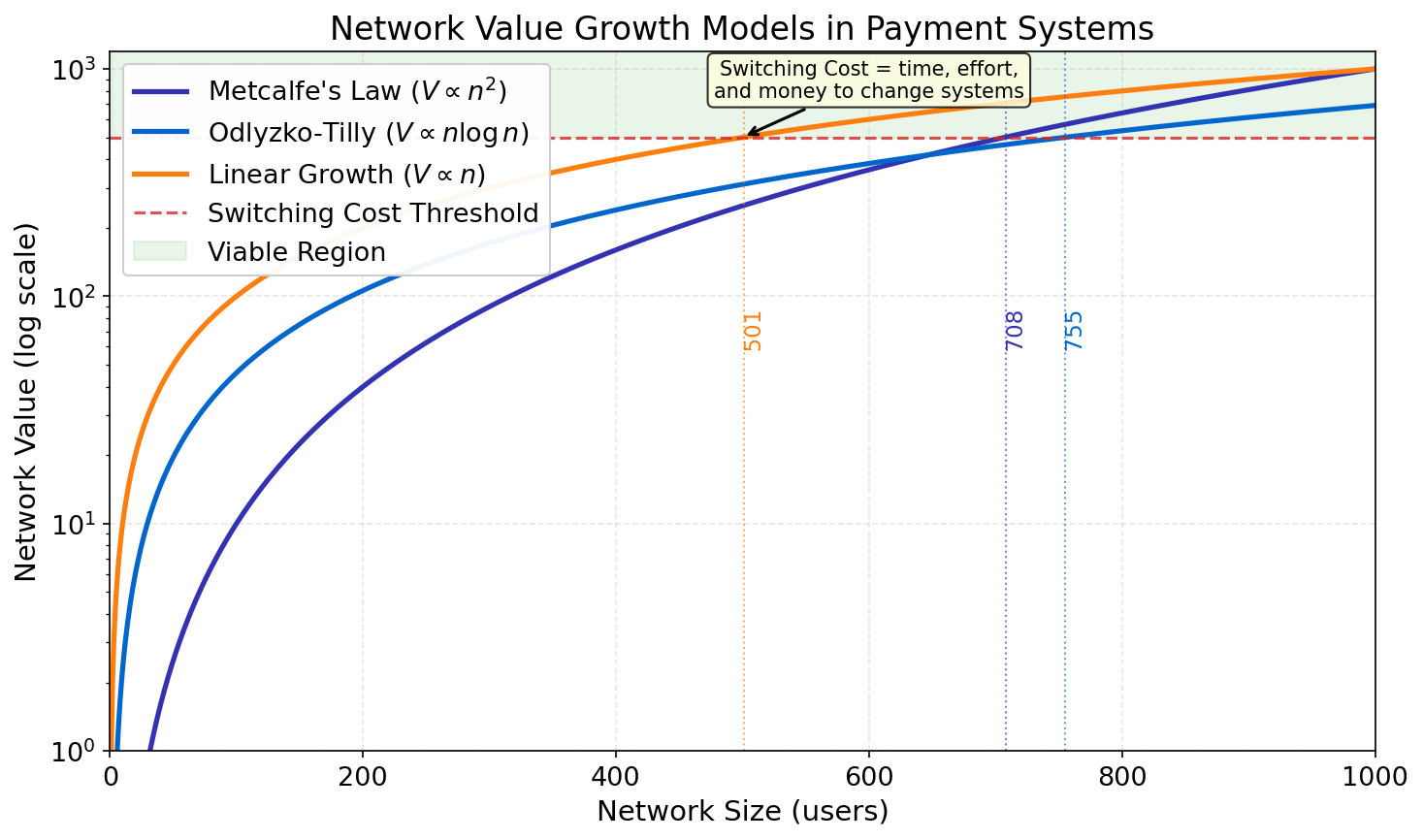
Key insight: Linear reaches critical mass FIRST (at n=500), while Metcalfe requires 42% more users (n=708). The n²/1000 scaling divisor means Metcalfe's quadratic advantage doesn't overcome the denominator until larger network sizes
Slide 4
Variation 1: Lower Threshold (100)
Critical mass points where V > 100:
- Linear: n = 100
- Metcalfe: n = 317 (√100,000 ≈ 316.2)
- Odlyzko: n ≈ 278
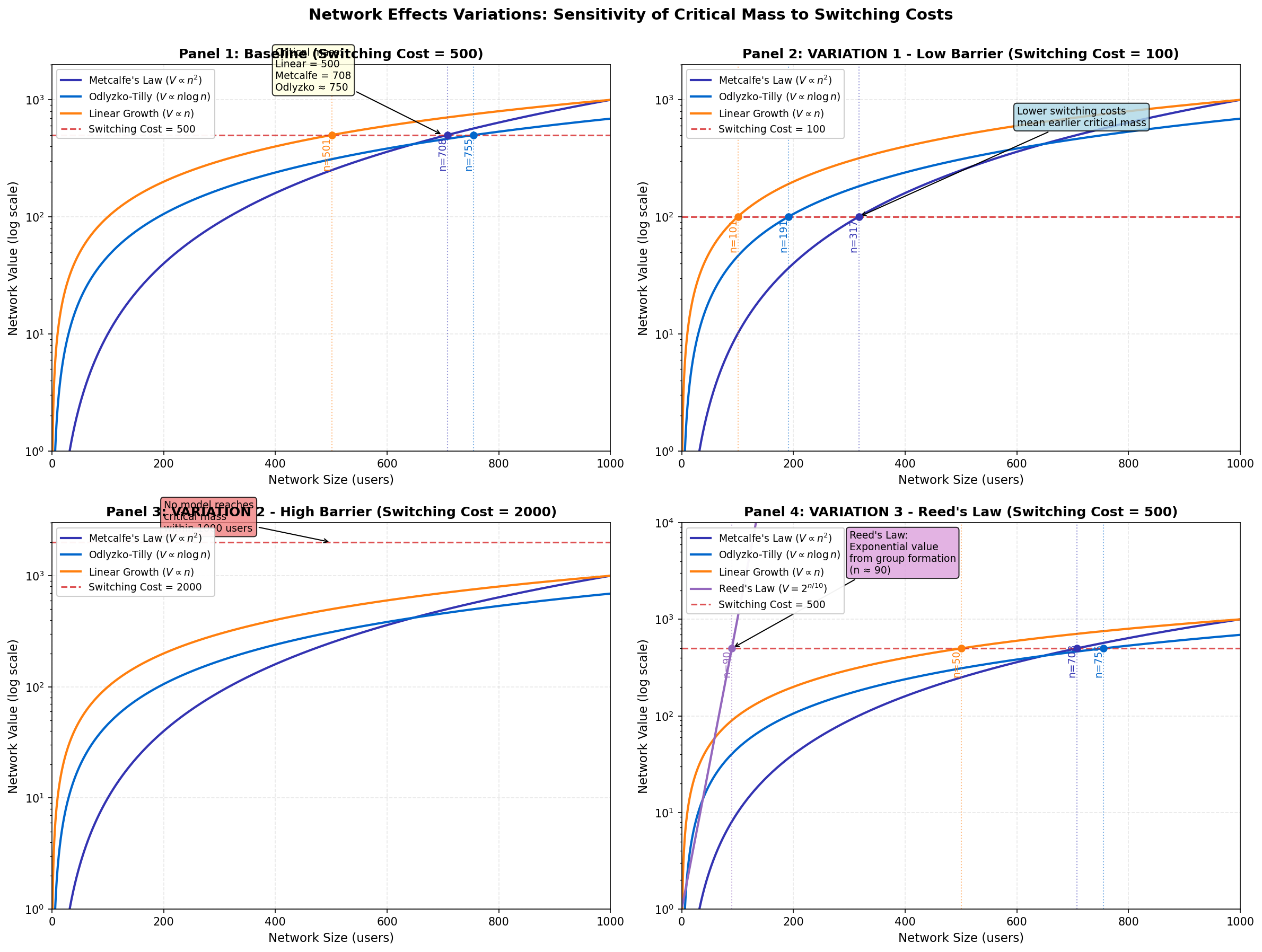
Key insight: Lower switching costs favor rapid adoption even with weak network effects