A3: Will CBDCs Kill Commercial Banks?
Introduction
A CBDC (Central Bank Digital Currency — digital money issued directly by a country's central bank, like a digital version of cash) could cause bank disintermediation (when people move their money from commercial banks to the central bank's digital currency). This model simulates how bank deposits D change over time using a differential equation (a formula describing how something changes from one moment to the next):
dD/dt = -α(r_CBDC - r_D)D + β·confidence(t)
Where:
- α (alpha) = rate sensitivity — how strongly the interest rate gap drives deposit outflow
- r_CBDC = interest rate on CBDC
- r_D = interest rate on bank deposits
- β (beta) = confidence sensitivity — how much public confidence affects deposits
- ODE = Ordinary Differential Equation — a math formula that describes continuous change over time
Variations to Explore
Variation 1: Increase Rate Sensitivity
Task: Change α from 0.8 to 2.0
Question: How much faster do deposits flee when people are more sensitive to interest rate differences?
Variation 2: Zero CBDC Interest Rate
Task: Set CBDC rate to 0% in all scenarios (instead of 0%, 1%, 2%)
Question: Do banks still lose deposits even if CBDC pays nothing? Why or why not?
Variation 3: Early Crisis
Task: Move crisis start from quarter 8 to quarter 2
Question: How does an early crisis change the outcomes? Why does timing matter?
Open Extension
Task: Add a "tiered CBDC" scenario where:
- CBDC pays 2% interest on the first EUR 3,000
- CBDC pays 0% interest above EUR 3,000
Question: How does this tiered structure protect banks compared to a flat 2% CBDC rate? Who benefits most from this policy design?
How to Run
- Google Colab (recommended): Upload the chart.py file to Google Colab
- Install dependencies: Run
!pip install scipyin a Colab cell (needed for solving the differential equation) - Run the code: Execute the chart.py file
- Create variations: Modify parameters and observe changes
Time Allocation
- 45 minutes: Run variations 1-3, analyze results, prepare slides
- 10 minutes: Present findings to class
Deliverables
- Presentation slides (5-7 slides) showing:
- The baseline model and what it means
- Results from all three variations with charts
- Your interpretation of what changes
- (Optional) Extension results for tiered CBDC
- Key insight: What is the most important policy lever for protecting banks from CBDC competition?
References
- Brunnermeier, M. K., & Niepelt, D. (2019). On the Equivalence of Private and Public Money. Journal of Monetary Economics, 106, 27-41.
- Bindseil, U. (2020). Tiered CBDC and the financial system. ECB Working Paper Series, No. 2351.
Show Model Answer Presentation
Slide 3
Baseline Results: Four Scenarios
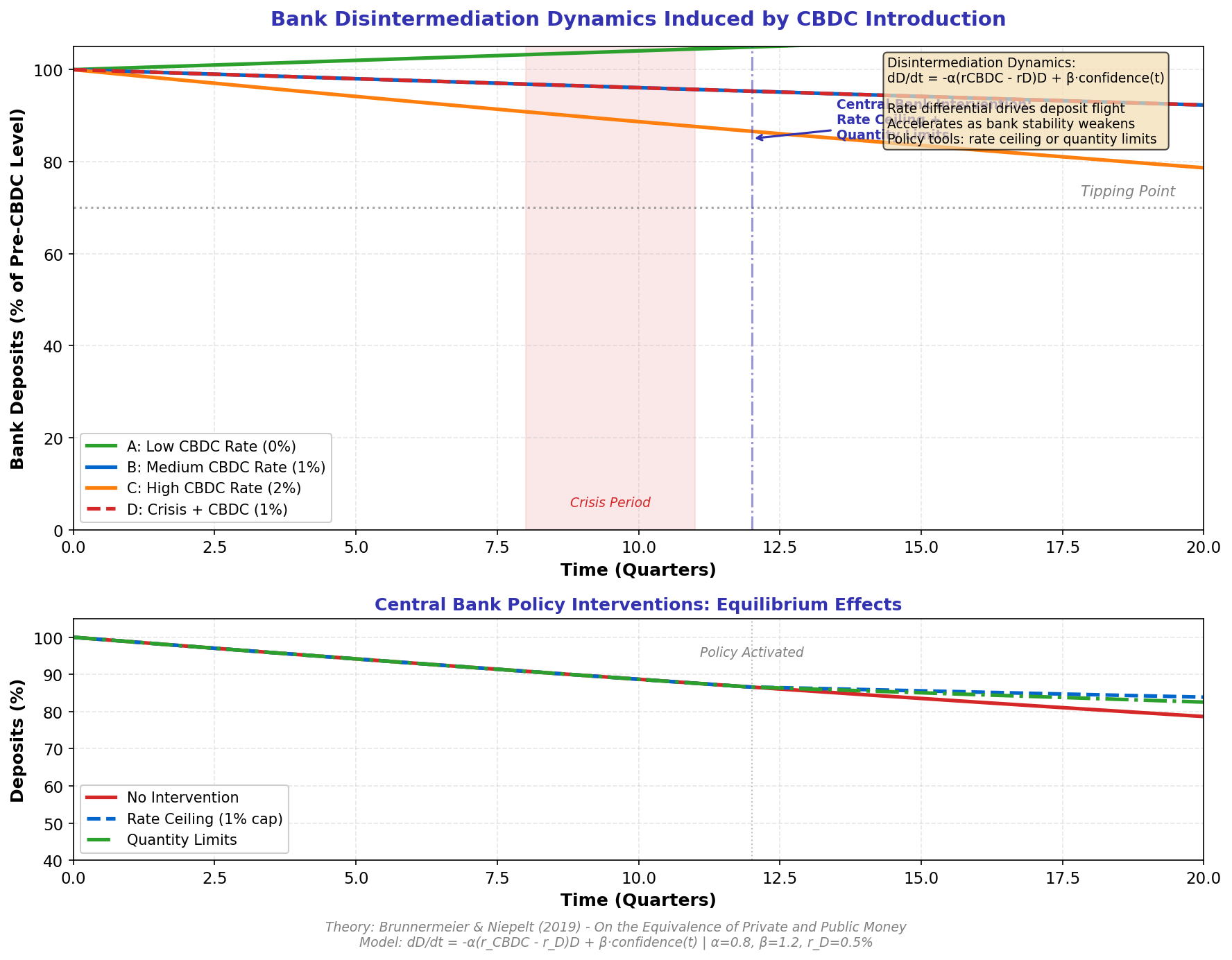
Key Findings:
- 0% CBDC rate (green): Deposits barely change (<5% loss over 5 years)
- 1% CBDC rate (blue): Deposits fall to ~85% after 5 years
- 2% CBDC rate (orange): Deposits crash to ~65% (35% loss)
- Crisis + 1% CBDC (red): Combined shock drives deposits to ~70%, nearing tipping point
Slide 4
Variation 1: High Rate Sensitivity (α = 2.0)
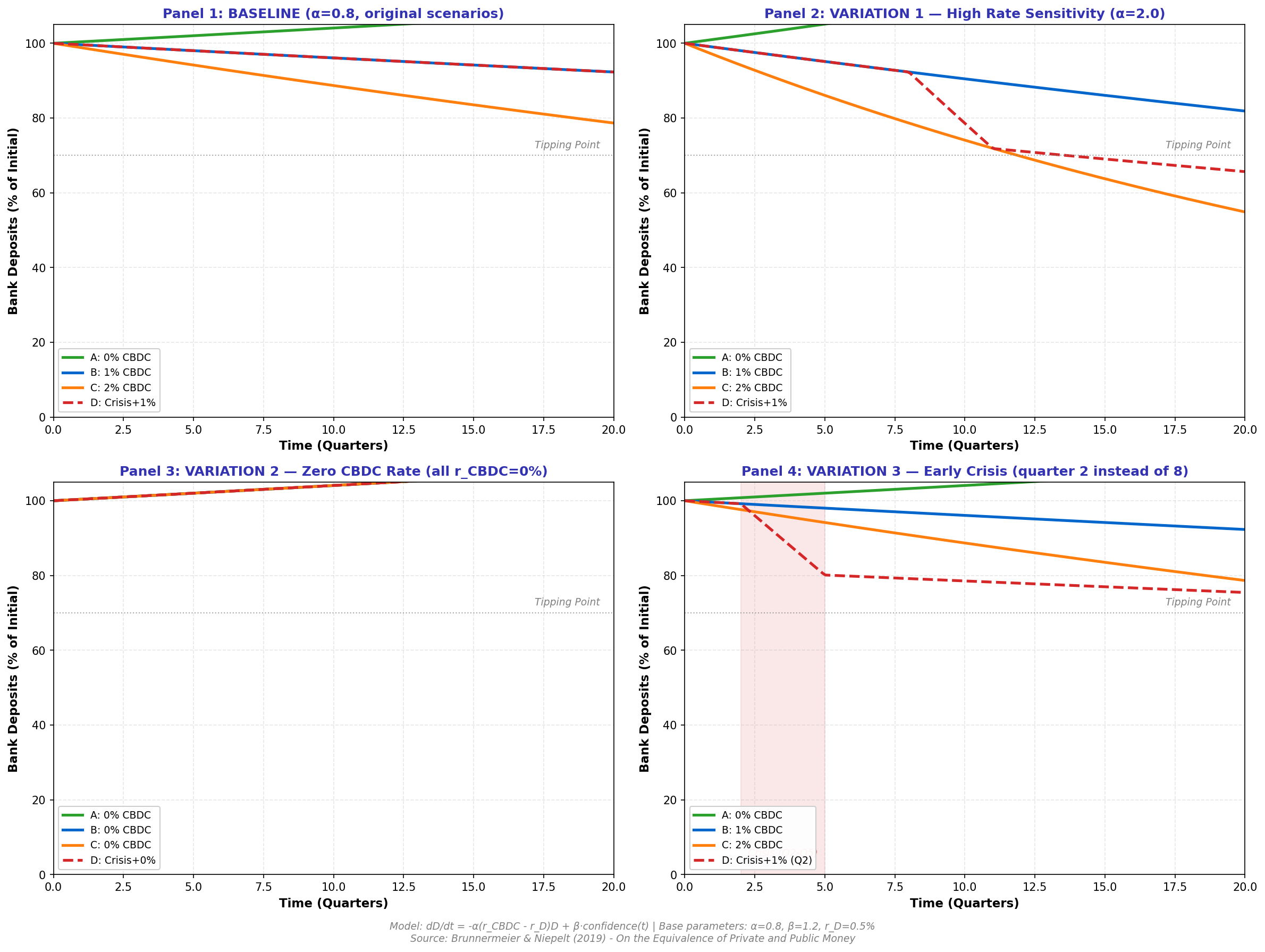
Panel 2 (top-right): When α = 2.0 instead of 0.8, deposit outflow accelerates dramatically.
Result: With 2% CBDC rate, deposits collapse to ~40% (60% loss) — bank failure territory.
Interpretation: If people are highly sensitive to interest rates, even small CBDC rate advantages trigger massive disintermediation.