Cryptoeconomics
The Science of Decentralized Systems
"Designing systems where rational self-interest produces collective benefit through the intersection of cryptography, economics, and game theory."
Start LearningWhy Study Cryptoeconomics?
Cryptoeconomics is not just about cryptocurrency. It's a new paradigm for designing systems where distributed participants coordinate toward shared goals without needing to trust each other or any central authority.
From Bitcoin's revolutionary solution to the double-spending problem, to Ethereum's programmable smart contracts, to the multi-billion dollar DeFi ecosystem - cryptoeconomics explains why these systems work when everyone involved is acting in their own self-interest.
Understanding these principles is essential for anyone who wants to:
- Build or invest in blockchain projects
- Understand the future of finance and digital assets
- Design incentive systems for any distributed platform
- Navigate the regulatory and business implications of crypto
The Three Pillars
Cryptoeconomics sits at the intersection of three disciplines. Each alone is insufficient - their combination creates something entirely new.
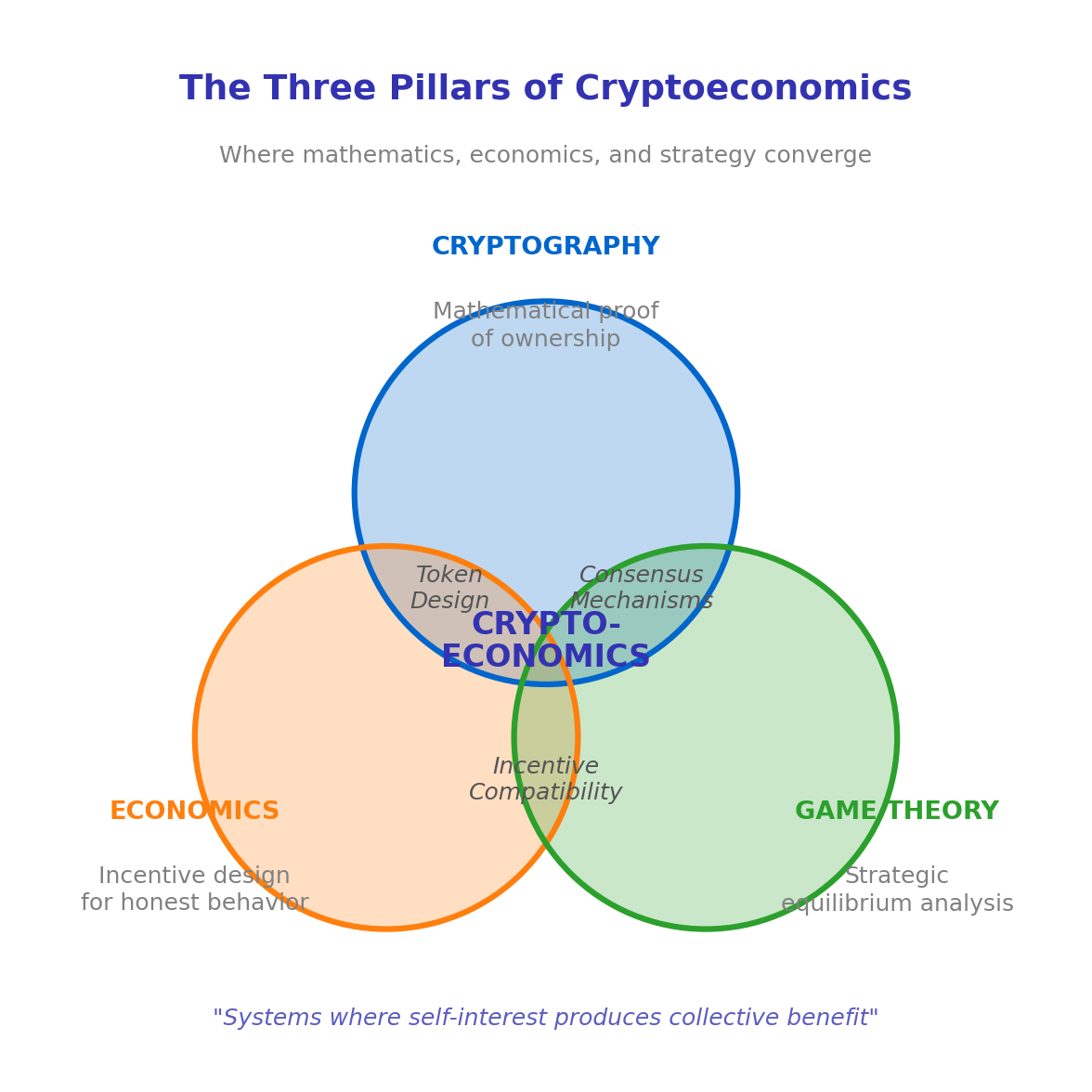
The convergence of cryptography, economics, and game theory creates cryptoeconomics
Cryptography
Mathematical proof of ownership, authenticity, and data integrity without trusting anyone
Economics
Incentive design that makes honest behavior more profitable than cheating
Game Theory
Strategic analysis proving that following the rules is every participant's best move
Your Learning Journey
The course takes you from first principles to real-world applications across four phases:
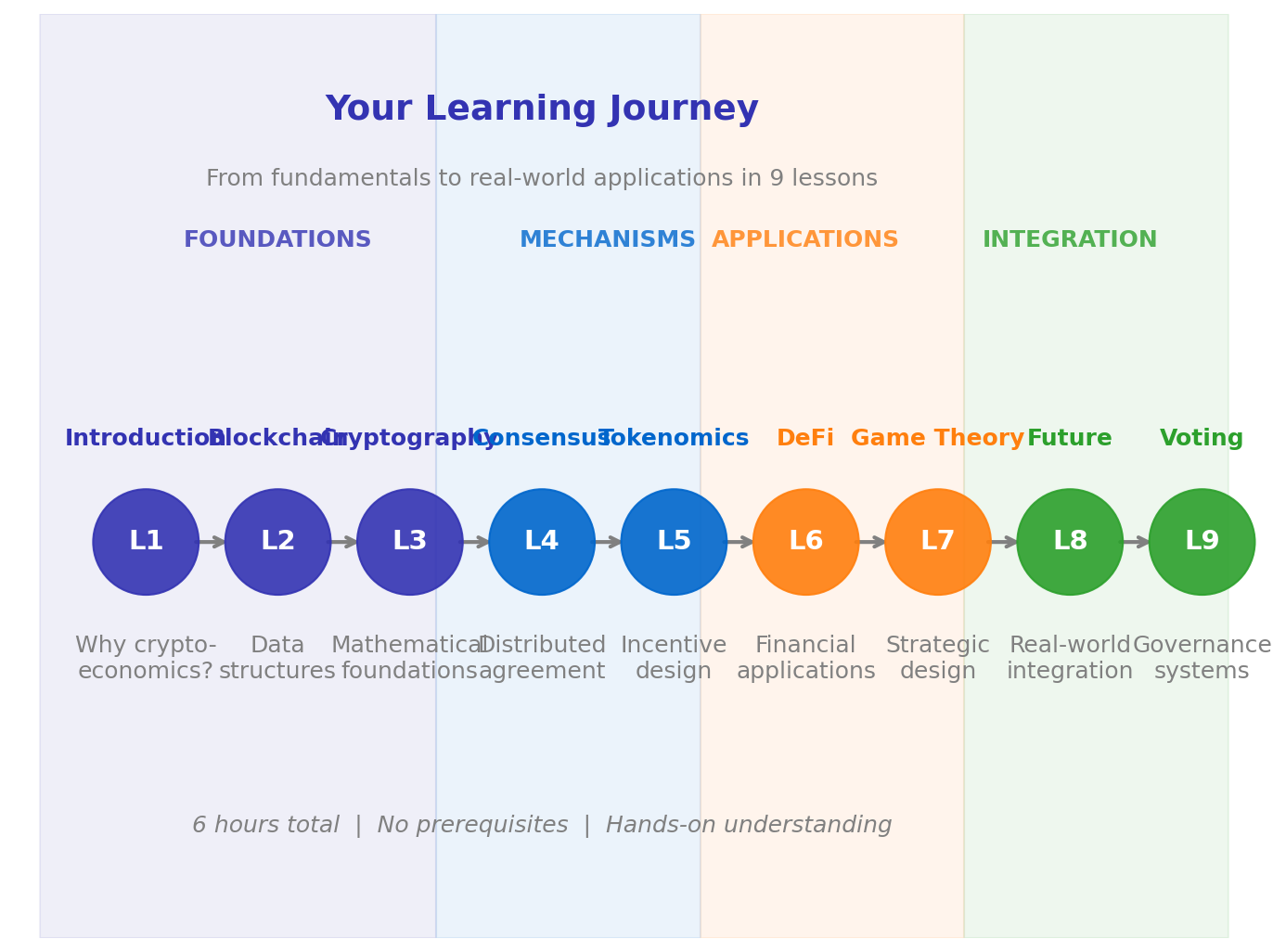
Nine lessons building from foundations to integration
Phase 1: Foundations (L1-L3)
Why cryptoeconomics matters, blockchain data structures, and cryptographic building blocks
Phase 2: Mechanisms (L4-L5)
How networks agree without central authority, and how tokens align incentives
Phase 3: Applications (L6-L7)
DeFi protocols that work in practice, and the game theory that explains why
Phase 4: Integration (L8)
Regulation, risks, CBDCs, and the future evolution of the ecosystem
What You'll Learn
By the end of this course, you'll have built comprehensive knowledge across three dimensions:
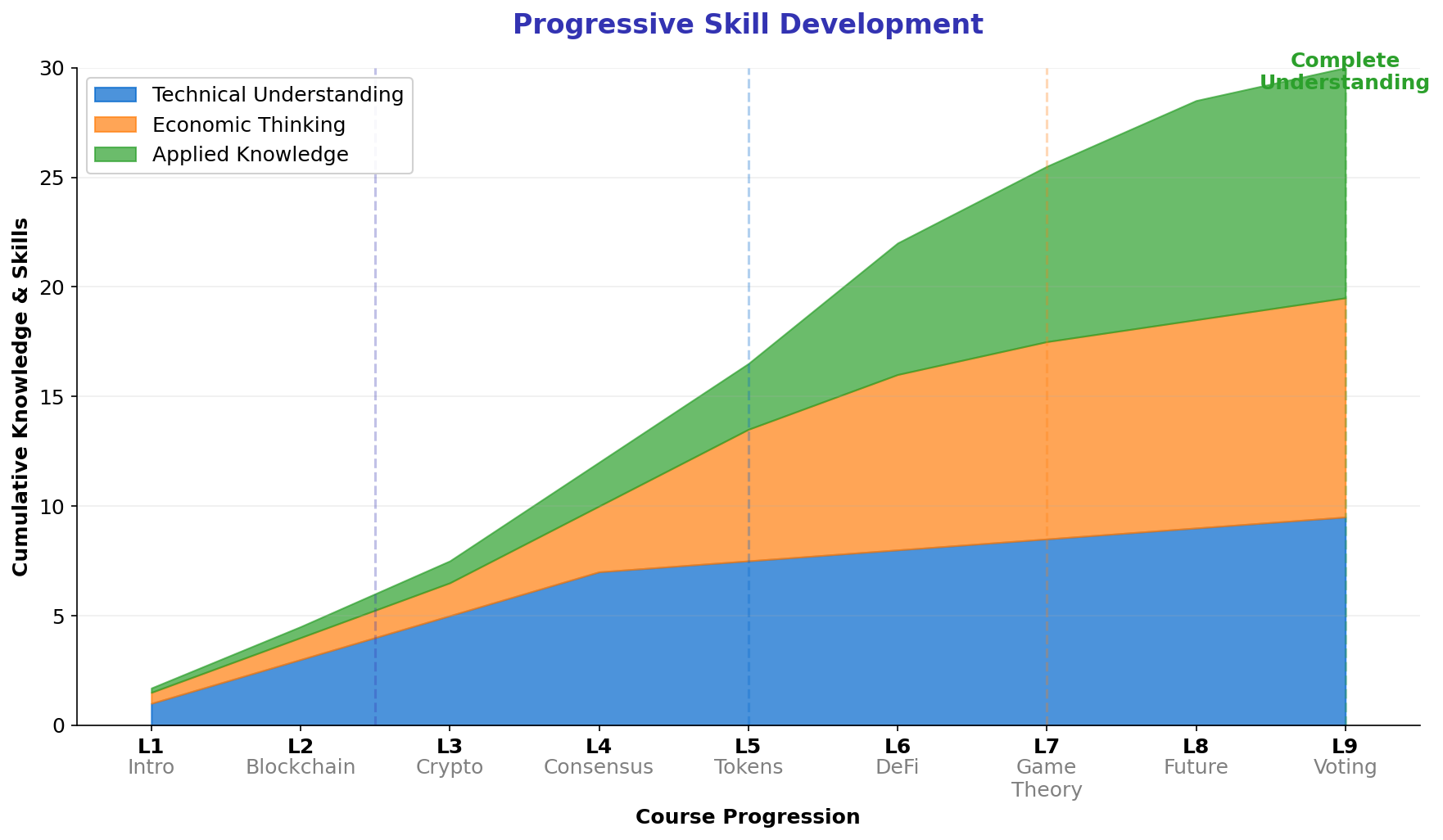
Progressive skill development across technical, economic, and applied domains
Technical Understanding
How blockchains, hashes, signatures, and consensus mechanisms actually work
Economic Thinking
Token design, incentive structures, and value accrual mechanisms
Strategic Analysis
Game theory, Nash equilibria, and mechanism design principles
Applied Knowledge
DeFi protocols, governance systems, and real-world regulatory context
Course Structure
Each lesson covers specific topics while building connections to concepts from other lessons:
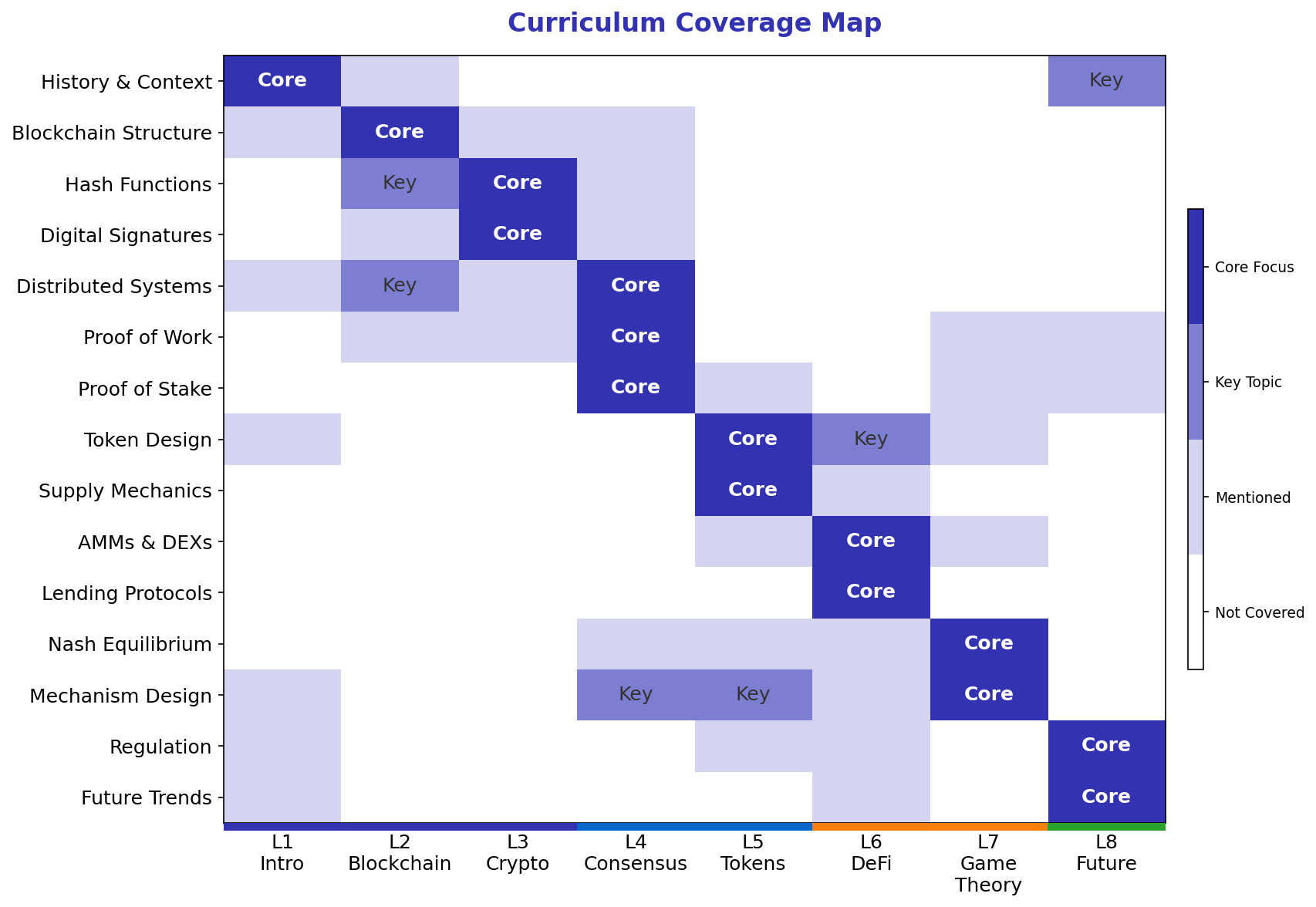
Curriculum coverage showing core focus areas and interconnections
Each of the 9 lessons includes:
- Full slides (30+ pages) - Comprehensive coverage with examples and diagrams
- Summary slides (10 pages) - Key concepts for quick review
- Visual charts - Python-generated visualizations of core concepts
- Learning objectives - Clear goals for each lesson
- Reflection questions - Prompts for deeper understanding
Who Is This For?
This course is designed for BSc-level students and professionals who want a rigorous introduction to cryptoeconomics. No prior knowledge of blockchain or cryptocurrency is required.
Helpful (but not required) background:
- Basic understanding of economics (supply/demand, incentives)
- Familiarity with probability concepts
- Comfort reading mathematical notation
By course completion, you will understand:
- Why decentralized systems matter fundamentally (not just a technology fad)
- How crypto achieves coordination without trusted intermediaries
- The economics of token design and incentive alignment
- Real applications: DeFi, governance, digital ownership
- Realistic limitations: regulatory, technical, and coordination challenges
- Future potential: integration with traditional finance, CBDCs, L2 scaling
Ready to Begin?
Access all 9 lessons with comprehensive slides and visual learning materials.
View All Lessons