Blockchain Foundations
Narrative arc: Problem (Slides 2–3) → Solution (Slides 4–6) → Stress test (Slide 7) → Evidence (Slide 8) → Nuance (Slide 9) → Synthesis (Slide 10)
Welcome to this mini-lecture on Blockchain Foundations. [pause] Over the next few minutes we answer one deceptively simple question: how do you create something scarce in a purely digital world? Let us begin.
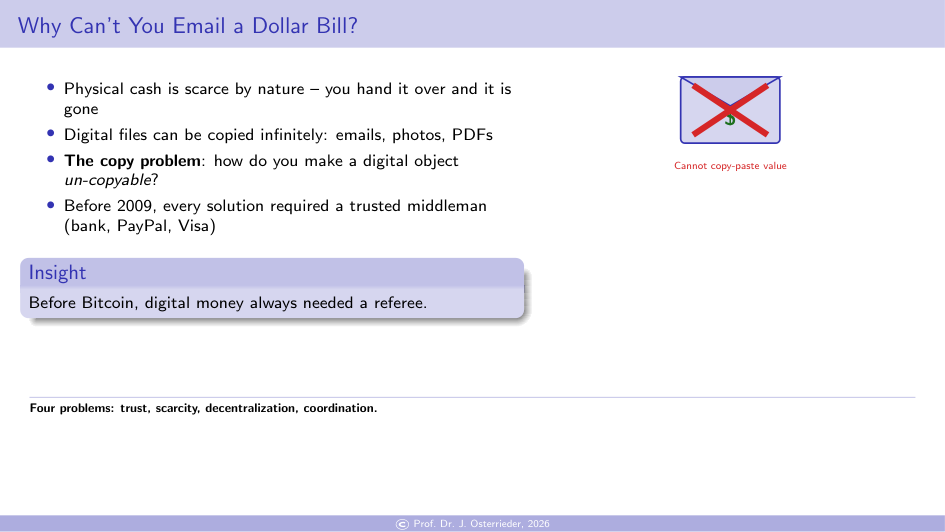
[point to slide] When you hand someone a banknote, it leaves your hand. But digital files can be copied infinitely at zero cost. [emphasize] So how do you make a digital object un-copyable? [pause] Before 2009, every answer required a trusted middleman — a bank, PayPal, Visa — someone to keep the ledger. [gesture to diagram] You cannot copy-paste value the way you copy-paste a file. [pause] Keep this copy problem in mind — it connects everything today.
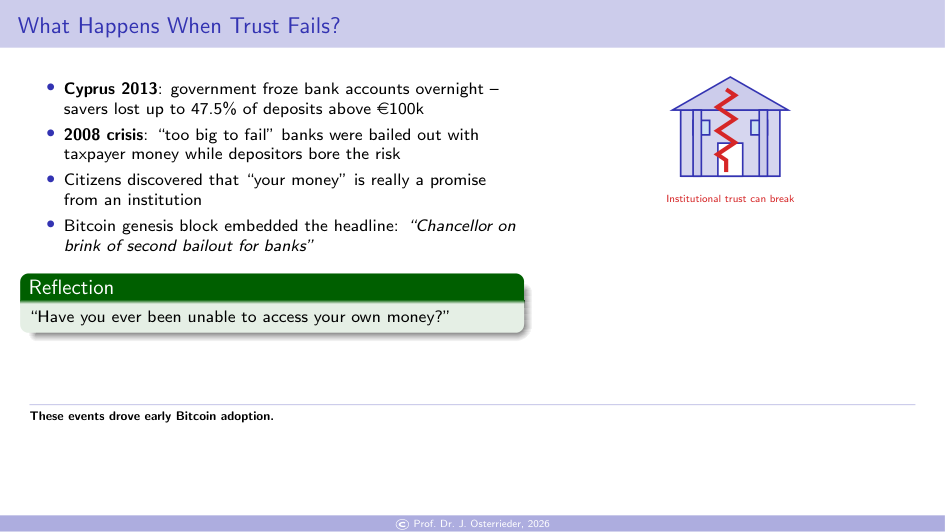
[point to slide] We rely on trusted middlemen — but what happens when that trust breaks? [pause] In 2013, Cyprus froze bank accounts overnight. Savers lost up to forty-seven and a half percent. [emphasize] No warning. [pause] In 2008, “too big to fail” banks got bailouts while depositors bore the risk. [pause] It is no coincidence that Bitcoin’s genesis block embedded: “Chancellor on brink of second bailout for banks.”
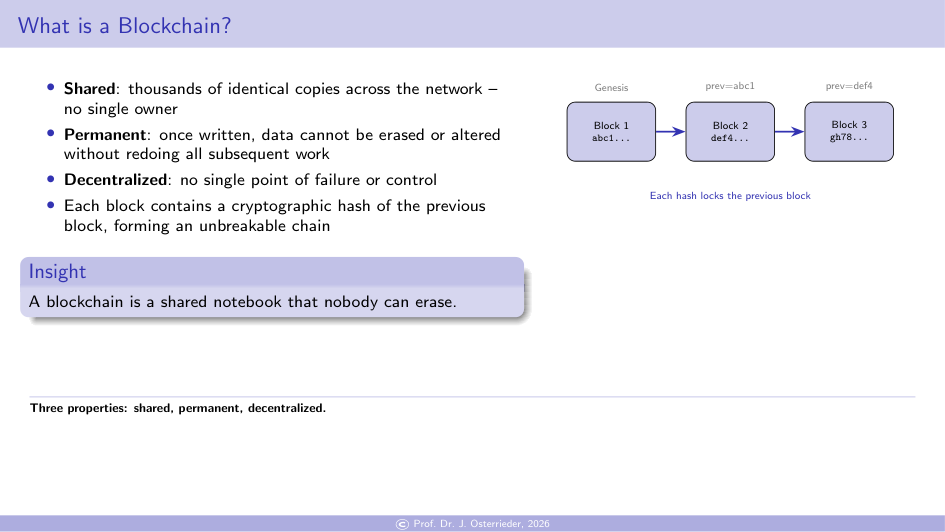
[point to slide] So what is a blockchain? [pause] Three properties. Shared — thousands of identical copies, no single owner. Permanent — data cannot be erased without redoing all subsequent work. Decentralized — no single point of failure. [gesture to diagram] Each block contains a hash of the previous block, locking the chain together. [emphasize] Think of it as a shared notebook nobody can erase. [pause] This answers the copy problem — trust mathematics instead of middlemen.
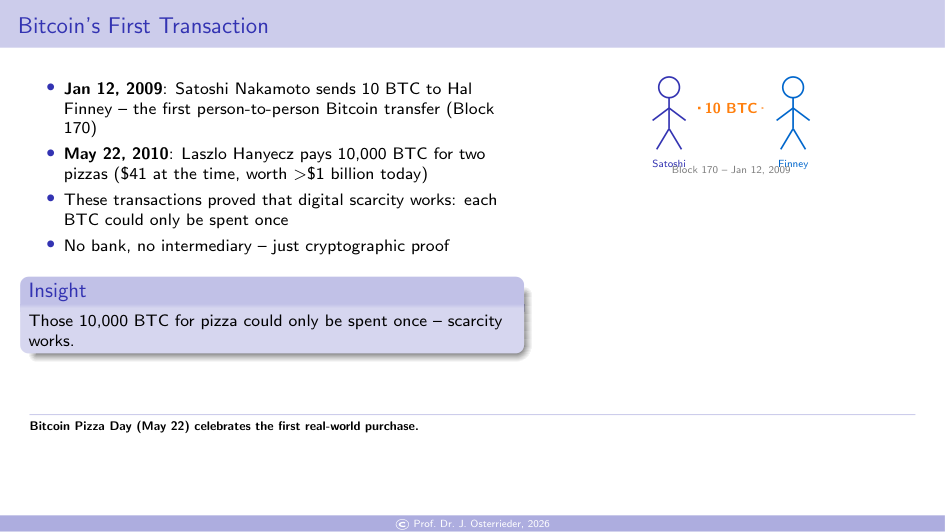
[point to slide] Did it actually work? [pause] On January twelfth, 2009, Satoshi Nakamoto sent ten bitcoin to Hal Finney — the first person-to-person transfer with no bank. [pause] Later, Laszlo Hanyecz paid ten thousand bitcoin for two pizzas. [emphasize] Those coins could only be spent once. Digital scarcity in action — no intermediary, just cryptographic proof. [pause] The copy problem — solved.
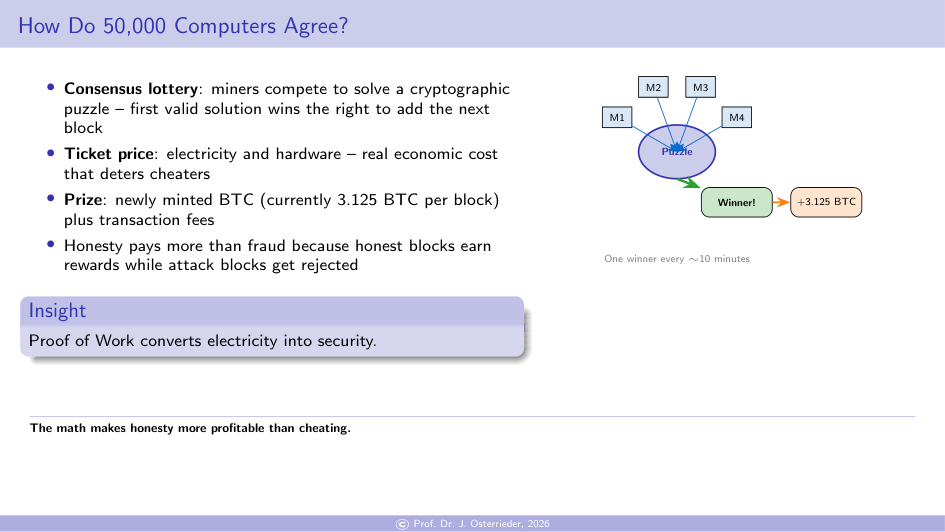
[point to slide] With no central authority, how do fifty thousand computers agree on valid transactions? [pause] A consensus lottery. Miners compete to solve a cryptographic puzzle; the winner adds the next block. [gesture to diagram] The ticket price is real — electricity and hardware. [pause] The prize: three point one-two-five bitcoin per block. [emphasize] Proof of Work converts electricity into security. Honesty pays more than fraud because attack blocks get rejected. [pause] This mechanism makes decentralization possible.
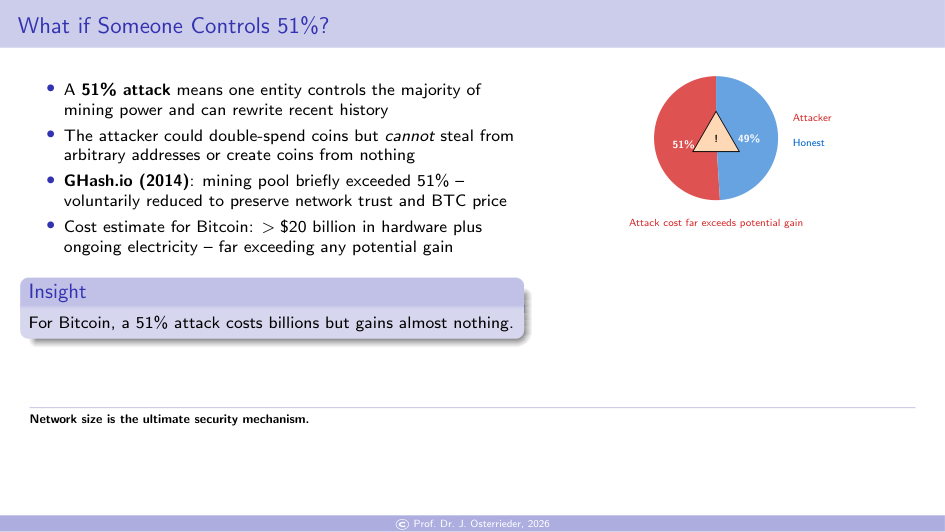
[point to slide] What if one entity controls the majority of computing power? [pause] A fifty-one percent attack could rewrite recent history. [emphasize] But it cannot steal from arbitrary addresses or create coins from nothing. [pause] In 2014, GHash.io briefly exceeded fifty-one percent and voluntarily reduced its share. Why? Attacking Bitcoin would cost over twenty billion dollars — far exceeding any gain. Cheating is unprofitable. That is decentralization’s security model.
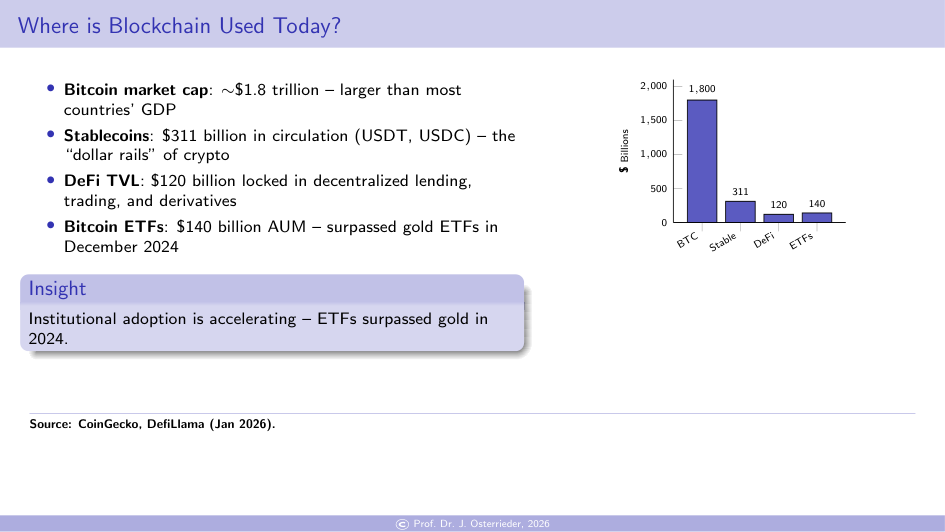
[point to slide] Where do we see this in practice? [pause] [gesture to diagram] Bitcoin’s market cap: one point eight trillion dollars. Stablecoins: three hundred eleven billion in circulation. DeFi: one hundred twenty billion locked. [emphasize] Bitcoin ETFs reached one hundred forty billion, surpassing gold ETFs in December 2024. Institutional adoption is no longer “if” — it is accelerating.
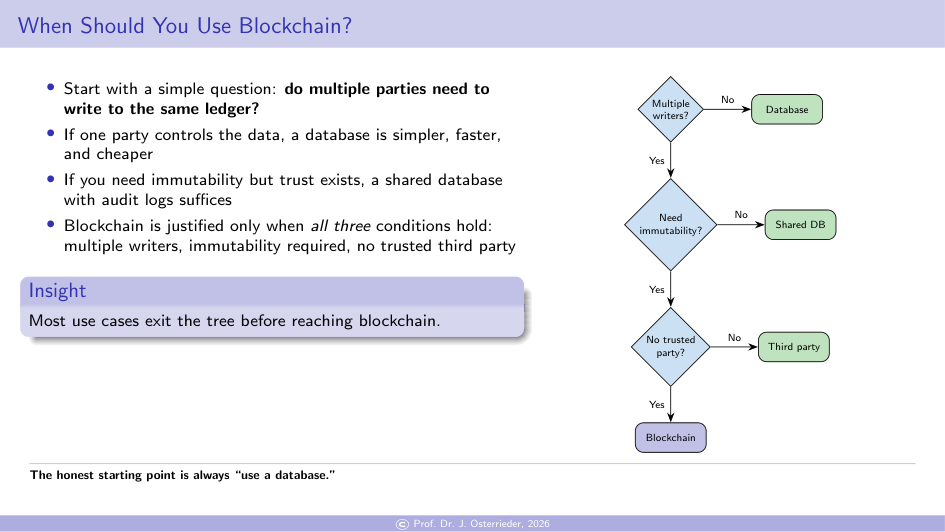
[point to slide] With all this momentum, should everything go on a blockchain? [pause] No. [gesture to diagram] This flowchart asks three questions: multiple writers needed? Immutability required? No trusted third party? [emphasize] Only when all three hold is blockchain justified. [pause] Most use cases exit before reaching blockchain. The honest starting point is: use a database. Blockchain is a tool, not a universal solution.
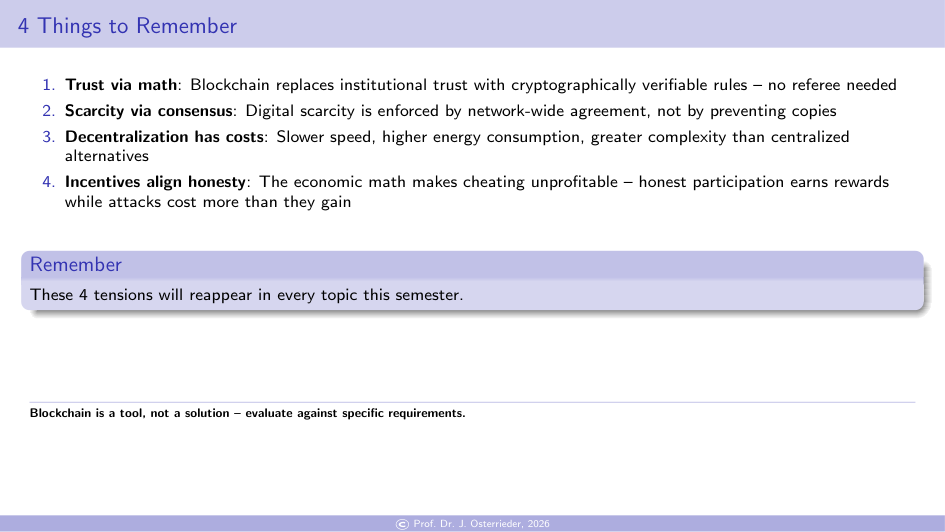
[point to slide] Four ideas to carry forward. [pause] First, trust via math — replace institutional trust with cryptographic rules. Second, scarcity via consensus — digital scarcity enforced by network agreement, not copy prevention. Third, decentralization has costs — slower speed, higher energy, greater complexity. [emphasize] Fourth, incentives align honesty — the economic math makes cheating unprofitable. [pause] These four tensions reappear in every topic this semester. Thank you.