"Approve or Deny?"
| Income ($k) | Debt Ratio | Credit Score | Outcome |
|---|---|---|---|
| 35 | 0.65 | 580 | Denied |
| 85 | 0.20 | 750 | Approved |
| 42 | 0.55 | 620 | Denied |
| 120 | 0.15 | 800 | Approved |
| 55 | 0.45 | 660 | Denied |
| 95 | 0.30 | 720 | Approved |
| 38 | 0.70 | 590 | Denied |
| 110 | 0.25 | 780 | Approved |
Your Task
- Sort by income -- does higher income always mean approval?
- Which single feature best separates approved from denied?
- Can you write a simple rule (e.g., "approve if credit score > __")?
Reveal Solution
No single feature perfectly separates the outcomes. We need a model that combines features and outputs a probability, not just yes/no. Logistic regression does exactly this: it maps a weighted sum of features through the sigmoid function to produce a probability between 0 and 1.
"The S-Shaped Curve"
Your Task
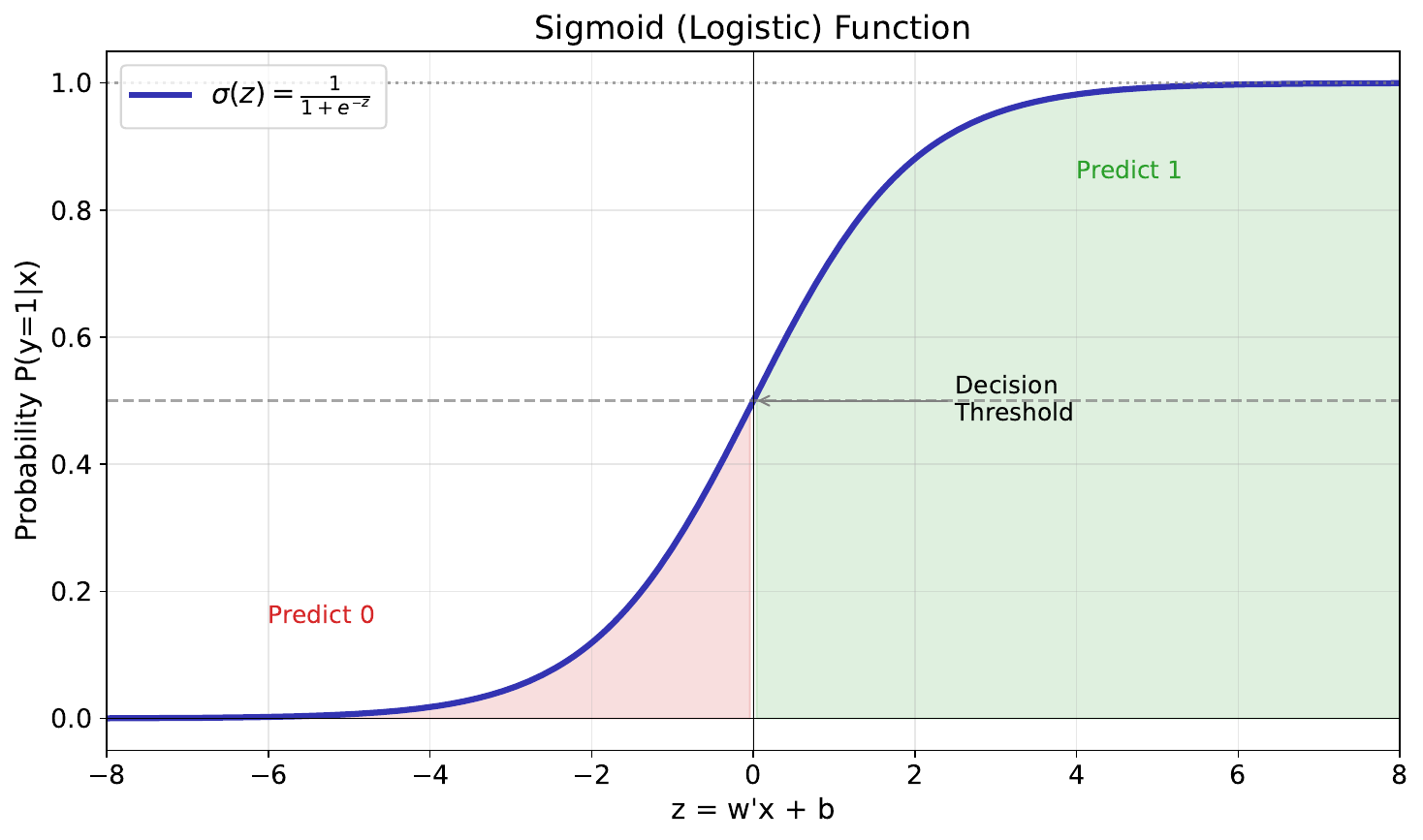
- What happens at the extremes -- very large or very small input?
- What is the output when the input equals 0?
- Why is this S-shape useful for modeling probabilities?
Reveal Solution
The sigmoid function $\sigma(z) = \frac{1}{1 + e^{-z}}$ maps any number to (0, 1). At extremes, it saturates near 0 or 1 (high confidence). At $z=0$, the output is 0.5 (maximum uncertainty). It's perfect for probabilities because it's smooth, monotonic, and bounded.
"Where Do You Draw the Line?"
Your Task
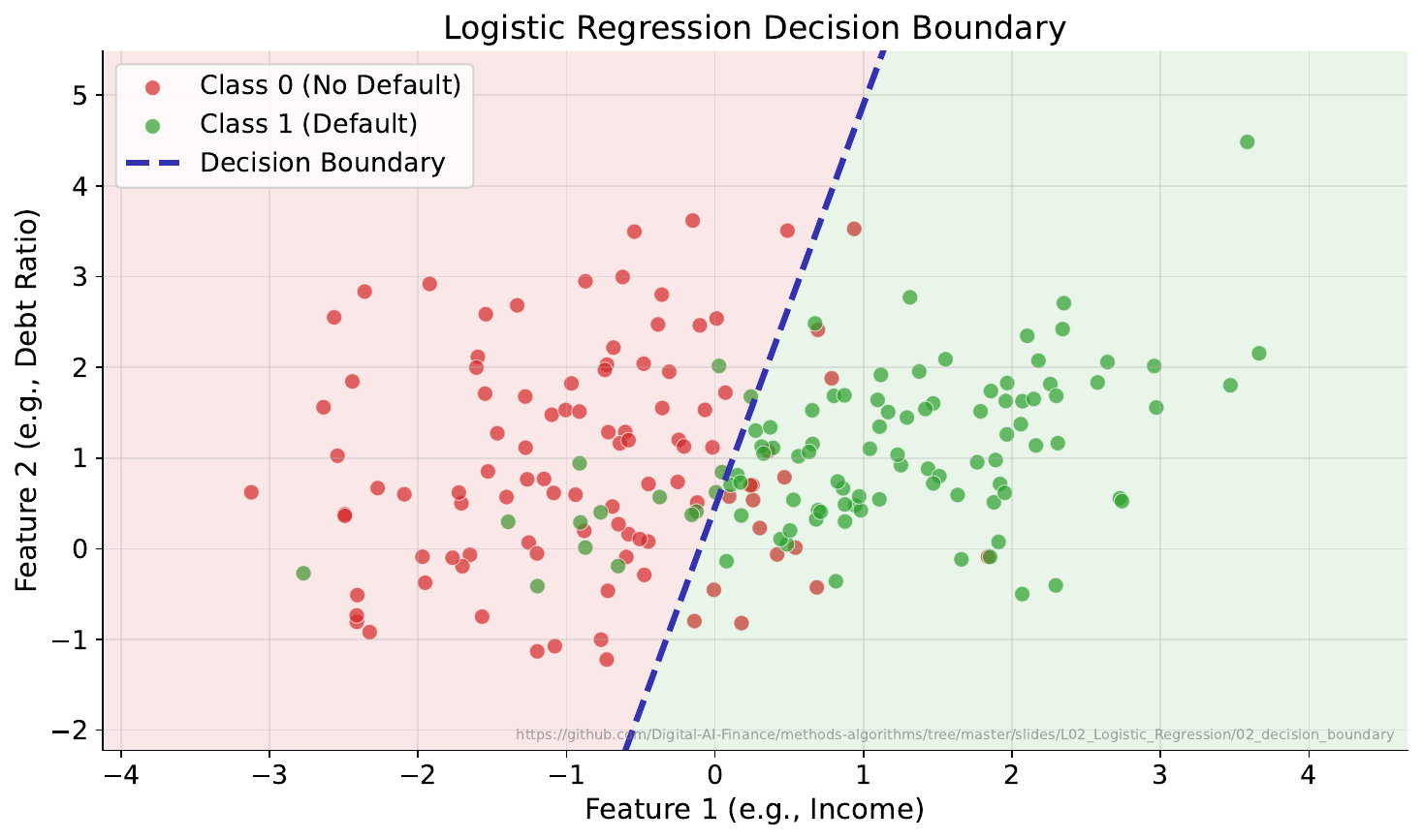
- Where would you place a boundary to separate the two groups?
- Can a straight line do it perfectly?
- What about the points near the boundary -- how confident should the model be about those?
Reveal Solution
The decision boundary is where $P(\text{class}=1) = 0.5$. In 2D feature space, logistic regression draws a straight line (or hyperplane in higher dimensions). Points near the boundary have probabilities close to 0.5 -- the model is uncertain. Points far away have probabilities near 0 or 1.
"The Confusion Table"
Your Task
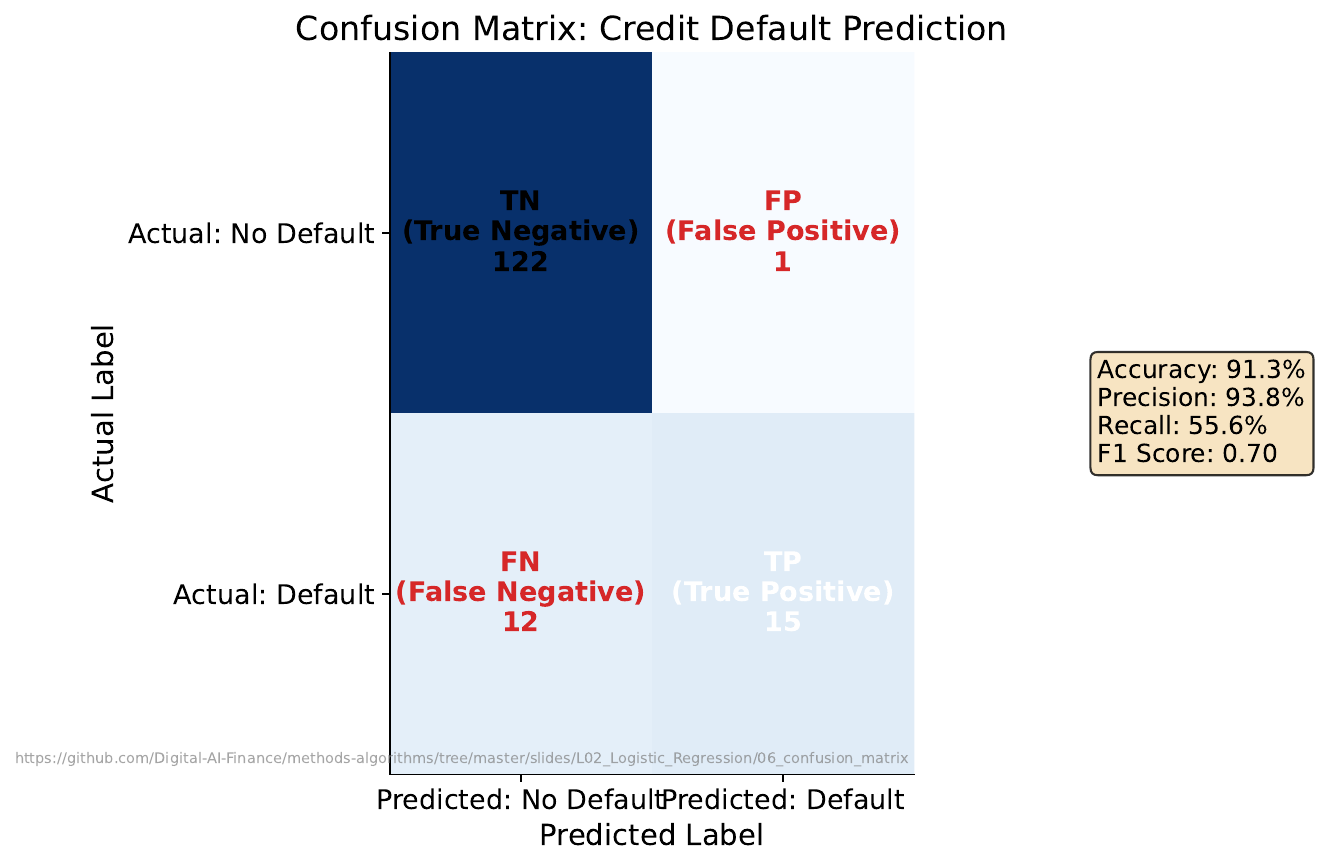
- In banking, which is worse: approving a bad loan (false positive) or rejecting a good customer (false negative)?
- Count the errors in each category.
- If you lower the approval threshold from 0.5 to 0.3, what changes?
Reveal Solution
The confusion matrix organizes predictions into TP, FP, TN, FN. Lowering the threshold approves more applicants -- increases true positives but also false positives. The trade-off between precision (how many approvals are correct) and recall (how many good customers you catch) is fundamental.
"Which Model Wins?"
Your Task
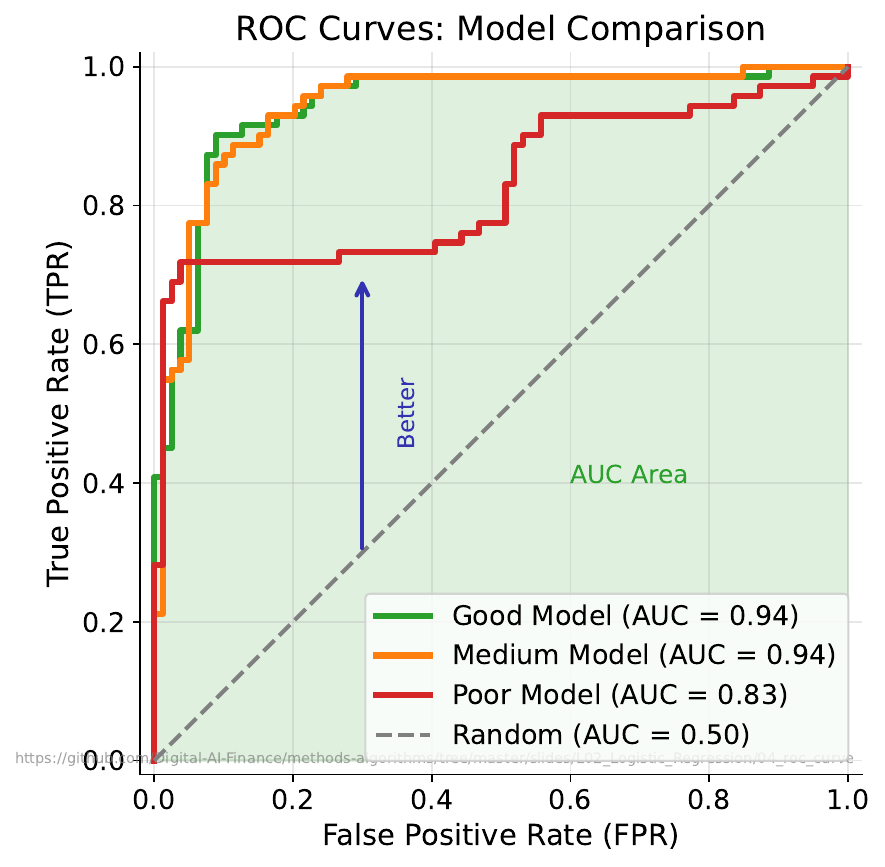
- What does the diagonal line represent?
- Which curve is better and why?
- Can a model be perfect -- what would that look like on this chart?
Reveal Solution
The diagonal is a random classifier (coin flip). The ROC curve plots True Positive Rate vs False Positive Rate at every threshold. A curve closer to the top-left is better. The AUC (Area Under Curve) summarizes performance: 0.5 = random, 1.0 = perfect. A perfect model reaches the top-left corner.
"Your Turn: Credit Scoring"
| # | Income ($k) | Debt Ratio | Credit Score | Your Prediction |
|---|---|---|---|---|
| 1 | 45 | 0.50 | 640 | ? |
| 2 | 90 | 0.25 | 730 | ? |
| 3 | 60 | 0.40 | 680 | ? |
| 4 | 75 | 0.35 | 700 | ? |
| 5 | 30 | 0.60 | 600 | ? |
| 6 | 105 | 0.20 | 760 | ? |
Your Task
- Predict approve/deny for each applicant.
- For each, rate your confidence from 0-100%.
- Two applicants (#3 and #4) have similar incomes but might get different outcomes -- why?
Reveal Solution
Logistic regression combines all features: $P(\text{approve}) = \sigma(\beta_0 + \beta_1 \cdot \text{income} + \beta_2 \cdot \text{debt} + \beta_3 \cdot \text{score})$. Each feature contributes -- debt ratio might penalize #3 enough to shift the probability. Your confidence ratings are you intuitively doing what logistic regression formalizes!