Green Finance Micro-Credential
A micro-credential worth 4 ECTS credits
Developed through WP3: Curriculum Development
Programme Overview
The GREEN FINANCE micro-credential curriculum is a comprehensive 5-module programme designed to equip professionals and students with essential green finance competencies. Developed collaboratively by EU and ASEAN partners, this curriculum bridges international standards with regional market needs.
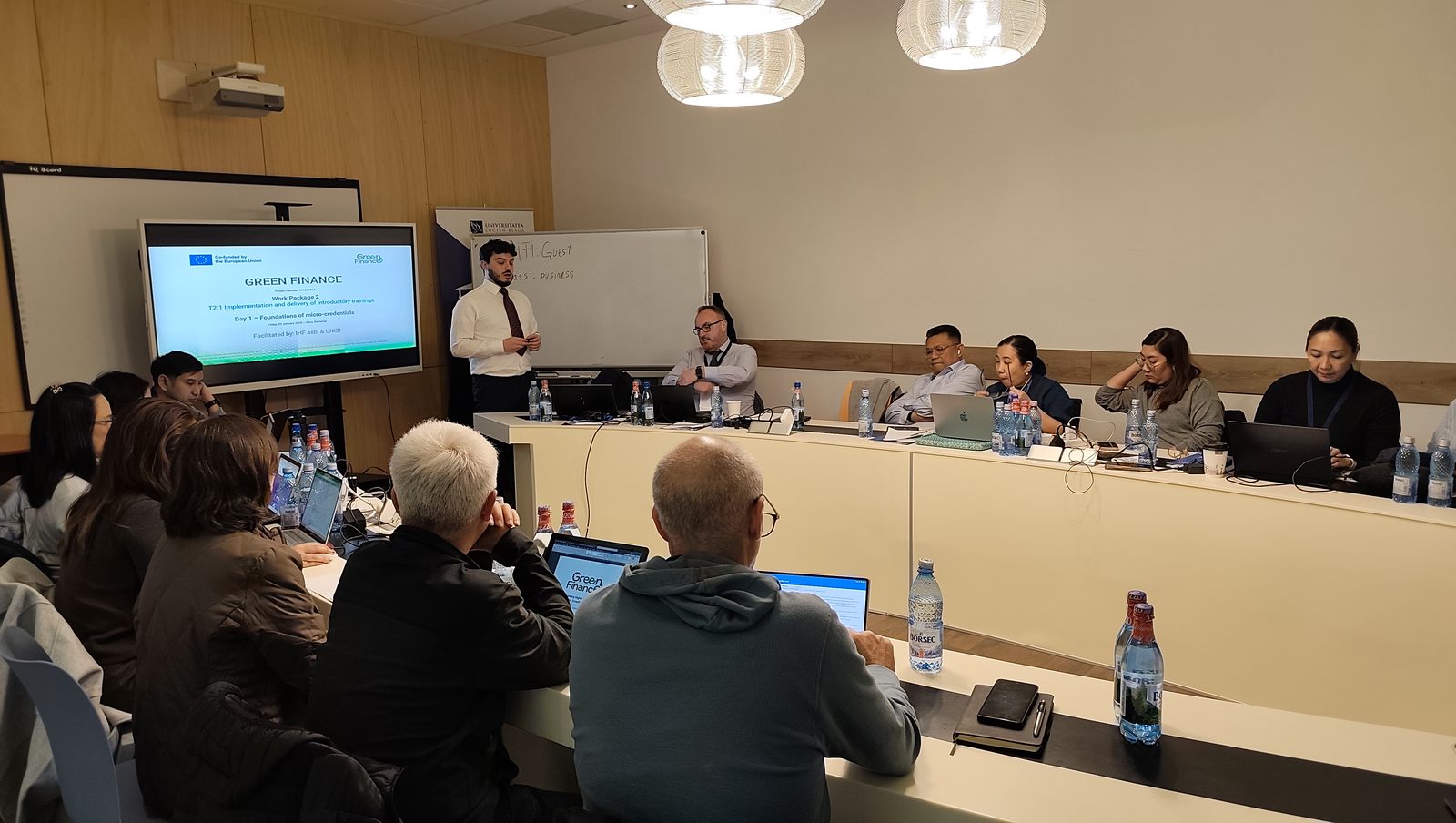
Curriculum development session, GREEN FINANCE Kick-Off, January 2026. Kick-off meeting, Lucian Blaga University of Sibiu, 23 to 25 January 2026. Photograph: GREEN FINANCE consortium.
Learning Pathway
Explore the Curriculum:
- View the complete 30-lesson curriculum grid: Interactive overview of all 5 modules
- Explore Module 4 Interactive Content: Risk Management with formulas, charts, and case studies
- PhD-Level Topic Explorer: Browse 72 PhD-level research topics (separate from micro-credential)
Developer Assignments
Each module is developed by a designated EU partner university:
Module Developers
| Module | Developer | University | Country |
|---|---|---|---|
| M1: Fundamentals and Building Blocks | ULBS | Lucian Blaga University of Sibiu | Romania |
| M2: Global, EU and ASEAN Contexts | IHF | IHF asbl | Belgium |
| M3: Green Finance Products and Services | UO | University of Opole | Poland |
| M4: Green Finance Risk Management | UT | University of Twente | Netherlands |
| M5: Green Reporting | TBD | To be determined | n/a |
For the project-level curriculum documentation with work package context, see Project Curriculum.
Module Overview
| Module | Title | Developer | Contact Hours | ECTS |
|---|---|---|---|---|
| 1 | Green Finance: Fundamentals and Building Blocks | ULBS | 20-24 | 0.8 |
| 2 | Green Finance in Global, EU and ASEAN Contexts | IHF | 20-24 | 0.8 |
| 3 | Green Finance Products and Services | UO | 20-24 | 0.8 |
| 4 | Green Finance Risk Management | UT | 20-24 | 0.8 |
| 5 | Green Reporting: Transparency, Accountability and Risk Communication | TBD | 20-24 | 0.8 |
Each module is 0.8 ECTS over 20 to 24 contact hours, and the five together make 4 ECTS across 100 to 120 hours of study. A learner earns the credit by completing all five modules and the assessment each one carries; a partner university awards it, and the October training week in Twente is staff training, so the hours a trainer attends there carry no credit of their own.
Regional Adaptation
Each ASEAN partner university adapts the core curriculum to their national context:
| Country | Universities | Adaptation Focus |
|---|---|---|
| Vietnam | BUH, BAV | Banking sector, JETP, Net Zero 2050 |
| Thailand | PU, WU | BCG Economy, Thailand 4.0 |
| Philippines | ADMU, WVSU | Climate resilience, green jobs |
Explore ASEAN Regional Context →
Resources
Shared teaching materials, assessment templates and ASEAN case studies are to be collected here as the modules are written. Nothing is published yet.
Module 4’s materials are the exception and are available now: see Module 4 teaching materials.
The five modules are listed together on the module index, with the lesson count and the credit weight of each.
Related Programmes
Looking for the 8-Week Professional Certificate? The GREEN FINANCE project also offers an intensive 8-week professional certificate programme covering comprehensive green finance topics across 296 pages of slides.
Acknowledgment
Co-funded by the European Union | Grant Agreement No. 101237817
This curriculum is developed under WP3 (Curriculum Development), led by the University of Twente, Netherlands.
(c) GREEN FINANCE Consortium 2026